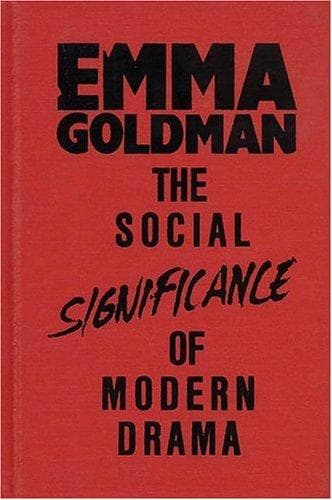
The Social Significance of the Modern DramaGoldman, Emma
History
The Social Significance of the Modern Drama
Goldman, Emma
Drama -- Social aspects; European drama -- History and criticism
_Trophimof._ If you have the household keys, throw them in the well
and go away. Be free, be free as the wind.... I am hungry as the
winter; I am sick, anxious, poor as a beggar. Fate has tossed me
hither and thither; I have been everywhere, everywhere. But
everywhere I have been, every minute, day and night, my soul has
been full of mysterious anticipations. I feel the approach of
happiness, Anya; I see it coming ... it is coming towards us, nearer
and nearer; I can hear the sound of its footsteps.... And if we do
not see it, if we do not know it, what does it matter? Others will
see it.
The new generation, on the threshold of the new epoch, hears the
approaching footsteps of the Future. And even if the Anyas and
Trophimofs of to-day will not see it, others will.
It was not given to Anton Tchekhof to see it with his bodily eyes. But
his prophetic vision beheld the coming of the New Day, and with powerful
pen he proclaimed it, that others might see it. Far from being a
pessimist, as charged by unintelligent critics, his faith was strong in
the possibilities of liberty.
This is the inspiring message of "The Cherry Orchard."
MAXIM GORKI
A NIGHT'S LODGING
We in America are conversant with tramp literature. A number of writers
of considerable note have described what is commonly called the
underworld, among them Josiah Flynt and Jack London, who have ably
interpreted the life and psychology of the outcast. But with all due
respect for their ability, it must be said that, after all, they wrote
only as onlookers, as observers. They were not tramps themselves, in the
real sense of the word. In "The Children of the Abyss" Jack London
relates that when he stood in the breadline, he had money, a room in a
good hotel, and a change of linen at hand. He was therefore not an
integral part of the underworld, of the homeless and hopeless.
Never before has anyone given such a true, realistic picture of the
social depths as Maxim Gorki, himself a denizen of the underworld from
his early childhood. At the age of eight he ran away from his
poverty-stricken, dismal home, and for many years thereafter he lived
the life of the _bosyaki_. He tramped through the length and breadth of
Russia; he lived with the peasant, the factory worker and the outcast.
He knew them intimately; he understood their psychology, for he was not
only with them, but of them. Therefore Gorki has been able to present
such a vivid picture of the underworld.
"A Night's Lodging" portrays a lodging house, hideous and foul, where
gather the social derelicts,--the thief, the gambler, the ex-artist, the
ex-aristocrat, the prostitute. All of them had at one time an ambition,
a goal, but because of their lack of will and the injustice and cruelty
of the world, they were forced into the depths and cast back whenever
they attempted to rise. They are the superfluous ones, dehumanized and
brutalized.
Public-domain text, read in full here on John Shaqi.
Reviews
Reviews
No reviews yet
Be the first to share your thoughts on this work.
Elsewhere in the archive
Join the Discussion
Join the discussion
Sign in to leave a comment or review.
Sign InorCreate an account