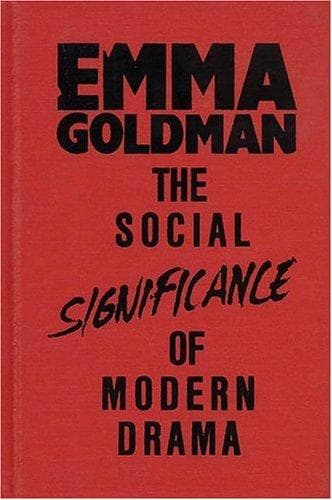
The Social Significance of the Modern DramaGoldman, Emma
History
The Social Significance of the Modern Drama
Goldman, Emma
Drama -- Social aspects; European drama -- History and criticism
_Third Workingman._ You lie, King-Hunger. Then you have killed my
father and grandfather and great-grandfather, and would'st thou kill
us? Where do you lead us, unarmed? Don't you see how ignorant we
are, how blind and impotent. You are a traitor. Only here you are a
king, but there you lackey upon their tables. Only here you wear a
crown, but there you walk about with a napkin.
_King-Hunger_ will not listen to their protest. He gives them the
alternative of rebellion or starvation for themselves and their
children. They decide to rebel, for _King-Hunger_ is the most powerful
king on earth.
The subjects of _King-Hunger_, the people of the underworld, gather to
devise ways and means of rebellion. A gruesome assembly this, held in
the cellar. Above is the palace ringing with music and laughter, the
fine ladies in gorgeous splendor, bedecked with flowers and costly
jewels, the tables laden with rich food and delicious wines. Everything
is most exquisite there, joyous and happy. And underneath, in the
cellar, the underworld is gathered, all the dregs of society: the robber
and the murderer, the thief and the prostitute, the gambler and the
drunkard. They have come to consult with each other how poverty is to
rebel, how to throw off the yoke, and what to do with the rich.
Various suggestions are made. One advises poisoning the supply of water.
But this is condemned on the ground that the people also have to drink
from the same source.
Another suggests that all books should be burned for they teach the rich
how to oppress. But the motion fails. What is the use of burning the
books? The wealthy have money; they will buy writers, poets and
scientists to make new books.
A third proposes that the children of the rich be killed. From the
darkest, most dismal corner of the cellar comes the protest of an old
woman: "Oh, not the children. Don't touch the children. I have buried
many of them myself. I know the pain of the mother. Besides, the
children are not to blame for the crimes of their parents. Don't touch
the children! The child is pure and sacred. Don't hurt the child!"
A little girl rises, a child of twelve with the face of the aged. She
announces that for the last four years she has given her body for money.
She had been sold by her mother because they needed bread for the
smaller children. During the four years of her terrible life, she has
consorted with all kinds of men, influential men, rich men, pious men.
They infected her. Therefore she proposes that the rich should be
infected.
The underworld plans and plots, and the gruesome meeting is closed with
a frenzied dance between _King-Hunger_ and _Death_, to the music of the
dance above.
* * * * *
Public-domain text, read in full here on John Shaqi.
Reviews
Reviews
No reviews yet
Be the first to share your thoughts on this work.
Elsewhere in the archive
Join the Discussion
Join the discussion
Sign in to leave a comment or review.
Sign InorCreate an account