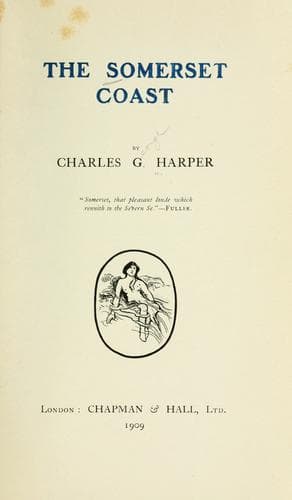
The Somerset CoastHarper, Charles G. (Charles George)
History
The Somerset Coast
Harper, Charles G. (Charles George)
Somerset (England) -- Description and travel
“September 3rd, 1747.—Got to Oare and then to the valley of the Lyn; the
scenery very bonny, like our own land, but the part extremely wild and
lonely. Wandered about and thought of the doings of the family when
here, which I gather were not peaceable.”
How very precious is that last phrase—and how entirely unconvincing! It
would, in short, were any claim to material things attached to these
pretensions, be impossible to establish it on such slight foundations.
The first printed collection of Doone legends is that to be found in
Cooper’s “Guide to Lynton,” published in 1853. It is derived from local
folklore and from a manuscript collection of stories made for the
Reverend J. R. Chanter in 1839. Among these legends, besides those of
the Doones, we have the wild tales of Tom Faggus, the North Devon and
Somerset highwayman, and his “enchanted strawberry horse,” and the
fantastic and particularly stupid “legend of the de Wichehalse
family,[6] utterly without foundation.”
Footnote 6:
See _The North Devon Coast_, pp. 25-33 for a complete exposure of the
lying “de Wichehalse” legend, which contains no particle of truth.
Caution is therefore evidently to be exercised before accepting anything
in the way of these folk-tales, which tell of a fierce and utterly
lawless band of Doones who dwelt up the Badgworthy Valley, from about
the time of the Commonwealth, in a collection of some eleven rude
stone-built huts, and lived by raiding the houses and stockyards of the
neighbouring farmers. One of these stories tells us how the band was at
length exterminated by the long-suffering countryside. One winter’s
night, it appears, when snow was lying upon the ground, they made a raid
upon Yenworthy Farm, a lonely farmstead which still stands, although
since those times rebuilt, in a deep valley between the high-road near
County Gate and Culbone. Here they were received with an unexpectedly
bold front. _Arma virumque cano_; only in this instance it is of arms
and the woman one must sing. It was, in short, the farmer’s wife who
stood at an open window and opened fire upon them with a long duck-gun
that is to this day preserved in the house. This scattering discharge
appears to have severely wounded one, or several, of the raiders, for
blood-tracks were traced in the snow, leading in the direction of
Badgworthy. That same night the same party (or perhaps really another
part of the numerous band) appeared at Exford, in midst of Exmoor, and
attacked a farmhouse, in which were only a servant girl and a child. The
servant hid in the oven, leaving the child in the kitchen. The robbers,
the legend goes on to declare, killed the infant, and went off, with the
mocking lines,
If any one asks who ’twas killed thee,
Tell ’em—the Doones of Badgery.
Public-domain text, read in full here on John Shaqi.
Reviews
Reviews
No reviews yet
Be the first to share your thoughts on this work.
Elsewhere in the archive
Join the Discussion
Join the discussion
Sign in to leave a comment or review.
Sign InorCreate an account