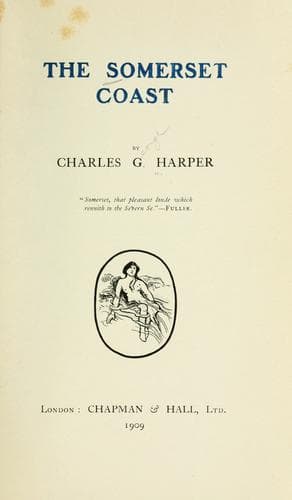
The Somerset CoastHarper, Charles G. (Charles George)
History
The Somerset Coast
Harper, Charles G. (Charles George)
Somerset (England) -- Description and travel
The fourth theory, and one stated to have been shared by Blackmore
himself (although he was not necessarily a prime expert in the matter)
is that the Doones were Scottish exiles. We have but to spell the name
“Doune” for it to be at once recognised as Scottish. Certainly it is no
West of England patronymic. At what period this view of the puzzle holds
those supposititious Dounes to have come from Scotland does not appear.
Scottish history may, if necessary, be made to afford many likely
junctures at which various people would find it advisable to seek a
sanctuary abroad. Of recent years an odd claim to relationship with the
Doones, involving an attempt to connect them with Scottish exiles, has
been made by the owner of a curiosity-shop at Hunstanton, Norfolk. This
person, Beeton by name, and his niece, one Ida M. Browne, who has
adopted the pseudonym “Audrie Doon” for literary purposes, have since
1901 produced what purport to be old family portraits, relics, and
documents, taking their history back to the seventeenth century and
connecting them and the Doones with the Earl of Moray of the early years
of that century. According to this story, a brother of the Earl of Moray
assumed the name of Doune, and after much persecution in the course of
family disputes over property, was obliged in 1620 to leave Scotland.
This “Sir Ensor Doune” as the claim has it, settled in this
neighbourhood, where he and his “were more or less hated and feared by
the countryside until their return to Perthshire in 1699.”
Thus Miss Ida M. Browne.
From this Sir Ensor Doune was descended (always according to this
showing) long lines of Dounes, or Doones.
Among the “family relics” is an old oil-painting, inscribed “Sir Ensor
Doune, 1679”; an ill-drawn daub representing an elderly man with small
crumb-brush whiskers, and an expression which leaves the beholder in
doubt as to whether he is half-drunk or half-mad: both Doone
characteristics, if we have followed the legends at all attentively.
Another item is an old flint-lock pistol inscribed on the barrel “C.
Doone, 1681, Porlok,” and furnished further with a representation of
skull and cross-bones. These, with a genealogy drawn up by one “Charles
Doone of Braemar,” bringing the family down from 1561 to 1804, are the
evidences adduced; together with what is put forward as the diary of a
“Rupert Doune,” stated to have been a fugitive from Scotland after the
rebellion of 1745. He, it appears, found his way at last to North Devon
and Somerset; to the districts in which his seventeenth-century forbears
had settled. Here are extracts from his journal:
“Sept. 3rd, 1747.—Went to Barum on my way to the place they call Oare,
where our people came after their cruel treatment at the hands of Earl
Moray.”
Public-domain text, read in full here on John Shaqi.
Reviews
Reviews
No reviews yet
Be the first to share your thoughts on this work.
Elsewhere in the archive
Join the Discussion
Join the discussion
Sign in to leave a comment or review.
Sign InorCreate an account