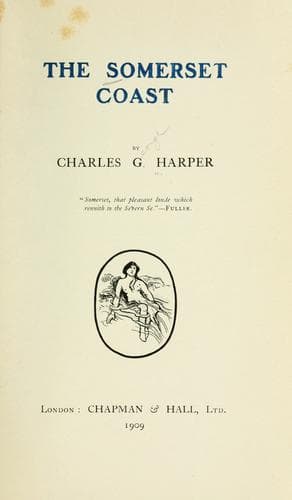
The Somerset CoastHarper, Charles G. (Charles George)
History
The Somerset Coast
Harper, Charles G. (Charles George)
Somerset (England) -- Description and travel
It is all the same beside the sea to Kilve, and rough walking too; the
rebuilt church of Kilton prominent inland, on the left; very modern, but
with a relic of a century ago in the shape of a battered old
barrel-organ with a set of mechanical psalm and hymn tunes, that used to
be ground out every Sunday to the long-suffering congregation, who must,
by dint of sheer damnable iteration, have come to loathe this unchanging
psalmody with a peculiar hatred.
We come now into the marches of West Somerset, where the folk-speech
still to some extent remains; but the famous broad “Zummerzet” speech of
these parts nowadays survives in its olden force only in the pages of
dialect novels. The dialect novel is a thing of convention, like the
dramatic stage, and is not necessarily a direct transcript from life. In
novels of rural life, in rustic plays, and in illustrated jokes in which
villagers appear, the countryman still wears a smock-frock and talks as
his great-grandfather was accustomed to talk. Frequently, too, he wears
a beaver hat, with a nap on it as luxuriant as the bristles of a
boot-brush; and he is made to smoke “churchwarden” clay pipes about a
yard long. Real rustics do not do these things nowadays. I only wish
they did; for then exploring in the byways would be much more
interesting. Nowadays, the unaccustomed Londoner can quite easily
understand anything a Somersetshire man, even of the most rustic type,
has to say.
This, however, is not to be taken as an assertion that all the old
characteristic words and phrases have died out, or that the accent is
altogether a thing of the past. The Somerset speech is really part and
parcel of that delightful West of England trick of the tongue which
still grows gradually more noticeable to the stranger as he progresses
westward. You will not notice this in any measure until you have passed
an imaginary line, which may be drawn from Oxford in the north, to
Southampton in the south, passing on the way such places as Wantage,
Newbury, Andover, and Winchester. Westward of this frontier-line, the
West of England, linguistically, commences. Somerset, by some
unexplained accident, was notoriously the home of the broadest speech;
but recent years have witnessed the singular phenomena (singular when
taken in conjunction) of Somerset folk-speech losing much of its
old-time character, and that of Devon, which had also largely fallen
into disuse, returning in almost its olden strength.
Public-domain text, read in full here on John Shaqi.
Reviews
Reviews
No reviews yet
Be the first to share your thoughts on this work.
Elsewhere in the archive
Join the Discussion
Join the discussion
Sign in to leave a comment or review.
Sign InorCreate an account