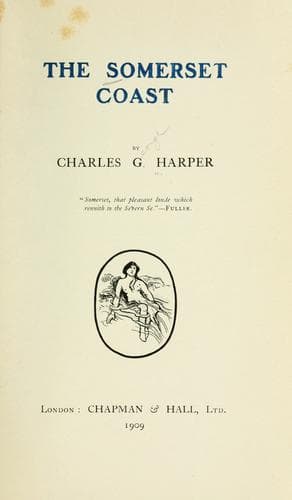
The Somerset CoastHarper, Charles G. (Charles George)
History
The Somerset Coast
Harper, Charles G. (Charles George)
Somerset (England) -- Description and travel
Much of this old manner of talking has been preserved in the
publications of the English Dialect Society, in which we find embedded,
among more stolid phrases, amusing scraps of rustic dialogues,
illustrating the local shibboleths. Here we have, for example, a rural
domestic quarrel, rendered in broad “Zummerzet.” It has not been thought
desirable to reproduce the somewhat pedantic inflection-marks given in
the Society’s publications, tending as they do towards the unnecessary
mystification of those who do not happen to be philologists. The
spelling has also been altered here and there, to bring it more into
line with the enunciation usually heard by the ordinary person.
The woman in this first specimen says, “Uneebaudee mud su waul bee u
tooüd uundur u aaruz bee u foauz tu leave saeumz aay bee, laung u dhee.
Tuz skandluz un sheemfeal aew aay bee zaard.”[3]
Footnote 3:
“Anybody might so well be a toad under a harrow as be forced to live
same as I be, long of thee. ’Tis scandalous and shameful how I be
served.”
To this pitiful complaint the husband answers, “U uumunz auvees zaard
wuul neef uur udn aat ubeawt, un dhee aart nuvvur aat ubeawt.”[4]
Footnote 4:
“A woman’s always served well if her isn’t hit about; and thee art
never hit about.”
Here is another example from the collection already quoted from:
“Taumee, haut bee yue aiteen on? Spaat ut aewt turaaklee!”
Perhaps the reader may be left to translate this. But how about the
following, spoken by a waggoner on a hot day? “Mudn maek zu boalz t’ax
vur koop u zaydur, aay spoüz? Aay zuuree aay bee dhaat druy, aay küdn
spaat zik-spuns.”[5]
Footnote 5:
“Mustn’t make so bold as to ask for a cup of cider, I suppose? I
assure you I be that dry, I couldn’t spit sixpence.”
Here again is some time-honoured “Zummerzet.” “Come, soce! Yur’s yur
jolly goed health. Drink ut oop tu onct!”
“Naw; daze muy ole buttonz neef aay due! Aay diddn nuvvur hold wi’
u-swillen of ut deown same uz thaet. Hurry no maen’s cattle tul ye’ve
got’n ass o’ yur aeown! Hurry, hurry; ’tuz this yur hurryen what tarns
everythen arsy-varsy vor me! Muy uymurz! what ood muy oal graanfer saay
tu th’ likes of ut? Wooden dh’oal maen laet aewt!”
[Illustration: KILVE CHURCH.]
Among the curious expressions found in this last speech, that of “soce”
is prominent. The word is a familiar expression in these parts. It is
used between equals, and is equivalent to “my boy,” “old chap,” etc.
Philologists generally consider it to be a survival from monastic times,
when itinerant monkish preachers are supposed to have been styled,
“socii,” _i.e._ “associates,” or “brethren,” or to have themselves used
the expression in addressing their congregations.
“This yur,” that is to say, reduced to ordinary pronunciation, “this
here” is, on the other hand, equivalent to a strong disapproval of the
subject under discussion. It means “this new-fangled,” unfamiliar, or
unpleasant thing.
Public-domain text, read in full here on John Shaqi.
Reviews
Reviews
No reviews yet
Be the first to share your thoughts on this work.
Elsewhere in the archive
Join the Discussion
Join the discussion
Sign in to leave a comment or review.
Sign InorCreate an account