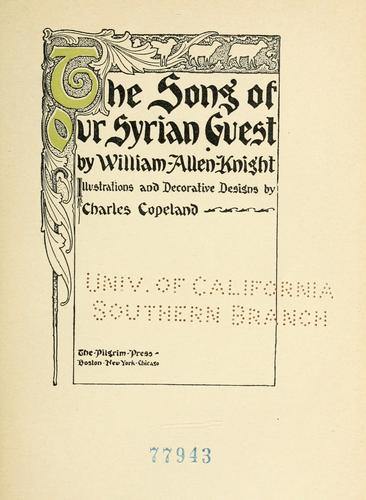
Bible. Psalms XXIII -- Criticism, interpretation, etc.
It has been asked and answered many times already. Because I know
some of you are in sick-rooms, some are lonely and some companioned
by grief, some are poor and some for the time are misunderstood,
some are discouraged and some feel themselves little loved, some
are young and cannot find their way, and some are old and
wayworn,--because I know all of you have need of the Shepherd's
watch, I want to answer your question. Yes, we did indeed have
such a guest, a man whose home was among the Syrian shepherds, a
man who well knew the life which rightly interprets the Shepherd
Psalm.
I give my word that this story's message about the Psalm's meaning
is straight from David's land. We had such a guest and he told us
these things out of the life of his people, as we sat together one
night over fragrant cups of tea.
W. A. K.
Boston, January, 1904.
Can there be anything more poetic than this life of the Syrian
shepherd? It ought to be religious, too. Far, far away, out on
the lone mountain, with the everlasting hills around, and heaven
above, pure, blue, and high, and still. There go and worship in
solemn silence and soul-subduing solitude, worship the Most High
God in his temple not made with hands.
And now the lights are out in the village, the shepherds are asleep
by the side of their flocks, the tinkling bell from the fold falls
faintly on the still night air, and the watch-dog bays drowsily
from his kennel at the gate. Good night, fair world; 'tis time to
seek repose. Let us first read and meditate upon that delightful
chapter, the tenth of St. John, where our blessed Saviour
appropriates all these characters of a good shepherd to himself.
"The Land and the Book."
"Faduel Moghabghab," said our guest, laughing as he leaned over the
tea-table toward two little maids, vainly trying to beguile their
willing and sweetly puckered lips into pronouncing his name.
"Faduel Moghabghab," he repeated in syllables, pointing to the card
he had passed to them. "Accent the u and drop those g's which your
little throats cannot manage," he went on kindly, while the
merriment sparkled in his dark eyes, and his milk-white teeth, seen
through his black moustache as he laughed, added beauty to his
delicate and vivacious face.
He was a man of winsome mind, this Syrian guest of ours, and the
spirituality of his culture was as marked as the refinement of his
manners. We shall long remember him for the tales told that
evening of his home in Ainzehalta on the slope of the Syrian
mountains, but longest of all for what he said out of the memories
of his youth about a shepherd song.
"It was out of the shepherd life of my country," he remarked, "that
there came long ago that sweetest religious song ever written--the
Twenty-third Psalm."
After the ripple of his merriment with the children had passed he
turned to me with a face now serious and pensive, and said: "Ah, so
many things familiar to us are strange to you of America."
Public-domain text, read in full here on John Shaqi.
Reviews
Reviews
No reviews yet
Be the first to share your thoughts on this work.
Join the Discussion
Join the discussion
Sign in to leave a comment or review.
Sign InorCreate an account