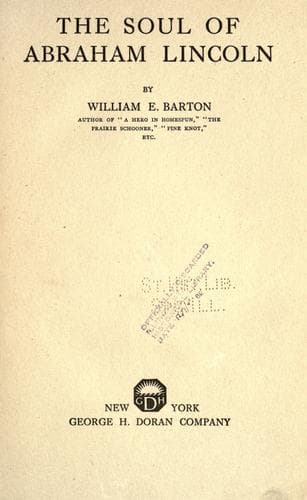
The Soul of Abraham LincolnBarton, William E. (William Eleazar)
Religion
The Soul of Abraham Lincoln
Barton, William E. (William Eleazar)
Lincoln, Abraham, 1809-1865 -- Religion; Presidents -- United States -- Biography
Hill and McNamur were partners, and Ann loved McNamur and rejected
Hill. McNamur went East, and was gone so long that it was believed he
was either dead or had proved untrue, and Hill's hope lit up again only
to meet a second disappointment. Ann Rutledge still loved McNamur, but,
believing him forever lost to her, she had made her second choice, and
that choice was not Hill. Hill awoke to the sad discovery that having
once been refused for his partner's sake he was refused again for the
sake of his clerk. This shy, gawky, lank, and ill-mannered young fellow
who was selling goods in Hill's store and studying law and cherishing
all manner of ambitions had aspired to the hand of Ann Rutledge and had
been accepted.
The truth about it came out in the discovery of a letter which Hill had
written to McNamur. Hill was making one last effort to learn whether
McNamur was living or dead, and if living whether he still loved Ann;
and was reproaching him for his delay and neglect. This letter did
not find its way to the post office; in some way it was lost and was
picked up by the children who brought it to Lincoln. This was the
document which Lincoln held in his hand when he and Hill came to their
final reckoning concerning the heart of Ann Rutledge; and the argument
between them, while friendly, developed some heat, and that was what
Hill snatched from Lincoln's hand and threw into the fire.
As for the book or essay or whatever it may have been in which Lincoln
passed on his undigested reading of Volney and Paine, we do not know
what became of that, nor need we greatly care. It went the way of a
good deal of literature which Lincoln was producing at this time,
probably with no dream that any of it would ever see a printing-press.
It is hardly credible that Lincoln, who never printed a book even in
his maturer years, should have had serious purpose of printing this
particular bit of half-fledged philosophy.
But we have knowledge, and very direct knowledge, of something else
which Lincoln wrote at this time. We learn of it not by any such
circuitous route of hearsay evidence as accompanies the story of the
so-called book on infidelity. We learn of it from a man who received
it at Lincoln's hands and who read it and remembered its contents and
was a competent witness not only as to the production of the book, but
also as to its argument. This is none other than Mentor Graham, the
schoolmaster of New Salem, who introduced Lincoln to Kirkham's Grammar,
who taught Lincoln surveying, who had Lincoln in his home as a lodger,
and who knew more about Lincoln's religious views during his years at
New Salem than any other man who lived to tell the world about it after
Lincoln's death. In Irwin's article, which we have already quoted, is
found this letter from Mentor Graham.
Public-domain text, read in full here on John Shaqi.
Reviews
Reviews
No reviews yet
Be the first to share your thoughts on this work.
Elsewhere in the archive
Join the Discussion
Join the discussion
Sign in to leave a comment or review.
Sign InorCreate an account