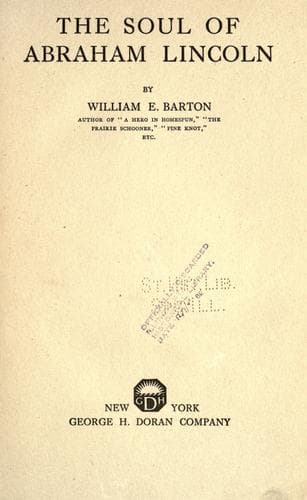
The Soul of Abraham LincolnBarton, William E. (William Eleazar)
Religion
The Soul of Abraham Lincoln
Barton, William E. (William Eleazar)
Lincoln, Abraham, 1809-1865 -- Religion; Presidents -- United States -- Biography
We have here our one witness that Mr. Lincoln while at New Salem,[41]
freshly risen from the reading of Volney and Paine, and having what
Lamon called the "itch for writing" wrote some kind of essay adverse to
the doctrines of Christianity as Lincoln then understood them. Matheny
never saw the book and never talked with anyone so far as we know who
had seen it, excepting Lincoln himself, who told him in confidence that
he had written such an essay. The fact that Matheny says that he "got
it as a secret" would seem to indicate that Lincoln had no pride in it,
and his reference to Herndon's insistence indicates that Herndon had no
other source of information.
Lincoln did, then, write something of this character and it may
have been burned; though it is extremely doubtful whether it met so
spectacular a fate or was anything like so formidable a document as
tradition has represented it.
It will be noted that Colonel Matheny says nothing about the burning of
the book. Herndon got that item from some other source, and apparently
misunderstood it. This information, apparently, Herndon picked up
on the occasion of his visit to New Salem. Samuel Hill may, indeed,
have reminded Lincoln that if he intended to run for the Legislature
against Peter Cartwright, it would be better for him not to be known
as an infidel; and indeed if Lincoln was known as an infidel, Peter
Cartwright was not the man to have failed to remind him of it. But at
the time when Samuel Hill snatched something out of Lincoln's hand and
threw it into the fire he was not concerned so much about Lincoln's
political future as he was about something else. The document which
Samuel Hill burned contained very little about theology.
When on an evening in November, 1866, Mr. Herndon, but lately returned
from his visit to the site of New Salem, delivered in the old court
house in Springfield before a small and critical audience his lecture
on Ann Rutledge, he informed his hearers that in 1834 that sweet young
girl of nineteen was simultaneously loved by three men, one of whom
was Abraham Lincoln. He omitted the names of the other two, and filled
in their place in the manuscript with blanks. The world has long since
learned the other two names, of John McNamur and Samuel Hill. Herndon's
reason for concealing them at the time was probably the fact that their
descendants were living near, but those descendants are well aware of
it now, and have been for years.
Public-domain text, read in full here on John Shaqi.
Reviews
Reviews
No reviews yet
Be the first to share your thoughts on this work.
Elsewhere in the archive
Join the Discussion
Join the discussion
Sign in to leave a comment or review.
Sign InorCreate an account