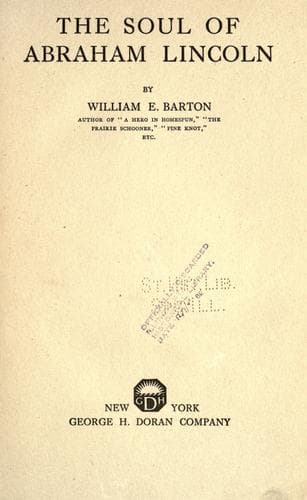
The Soul of Abraham LincolnBarton, William E. (William Eleazar)
Religion
The Soul of Abraham Lincoln
Barton, William E. (William Eleazar)
Lincoln, Abraham, 1809-1865 -- Religion; Presidents -- United States -- Biography
The second, and subsequent editions, of _Vestiges_ were "Greatly
Amended by the Author," as the title page gave notice, and the changes
were partly to incorporate new scientific data, but more to make clear
the fact that the author's theory did not remove God from his universe,
as some critics had asserted, but like Butler's _Analogy_ had shown
that God is in His world, working through the processes of nature.
In 1846 appeared _Explanations: A Sequel to Vestiges of the Natural
History of Creation_, a thin volume added to carry still further this
double purpose, and doing it with marked success. The sixth edition
combined the two in one volume.
It is interesting to learn that Lincoln, having read the first edition,
later procured and read the sixth, in which the religious spirit of the
author was made still more apparent.
This was the book which gave to Lincoln his theory of creation, of
"miracles under law," and with one divine mind and purpose working
through it all. Lincoln read little of natural science and cared
practically nothing for philosophy, but he found in this book what he
needed of both; and he found them in a system whose soul and center was
the will of a righteous God.
CHAPTER XV
OTHER FORMATIVE BOOKS
WE do not know of any other books which deserve to be classed with the
two we have been considering in their relation to the formation of
Mr. Lincoln's religious ideas; but our inquiry is at a point where it
will be instructive to learn of any collateral influence which at this
period, the period of the 50's, after the death of Eddie, and before
his election as President, helped to give shape to his convictions.
Mr. Lincoln did not unite with Dr. Smith's church. It is difficult
to think that it would have been possible for him to have done so.
Old-school Calvinism had its permanent influence upon him through his
Baptist antecedents, but while that of Dr. Smith came to him most
opportunely, it did not wholly meet his spiritual requirements.
For many years Herndon was in regular correspondence with Theodore
Parker. They agreed in their view of the slavery question, and had much
in common in their religion. Herndon had Parker's theological books,
and Lincoln read them, not very thoroughly, perhaps, but with interest.
About the same time, Mr. Jesse W. Fell, for whom he wrote the first
sketch of his life, presented him with the works of William E. Channing.
When Herndon was gathering material to confute Dr. Reed, he assembled
very nearly everything that seemed to prove that Lincoln was not
orthodox, however far short it fell of proving him an infidel. Among
the rest he interviewed Fell, and from his statements made up this
report, which appeared in Lamon's book, and subsequently in Herndon's:
"Mr. Jesse W. Fell of Illinois, who had the best opportunities of
knowing Mr. Lincoln intimately, makes the following statement of his
religious opinions, derived from repeated conversations with him on
the subject:
Public-domain text, read in full here on John Shaqi.
Reviews
Reviews
No reviews yet
Be the first to share your thoughts on this work.
Elsewhere in the archive
Join the Discussion
Join the discussion
Sign in to leave a comment or review.
Sign InorCreate an account