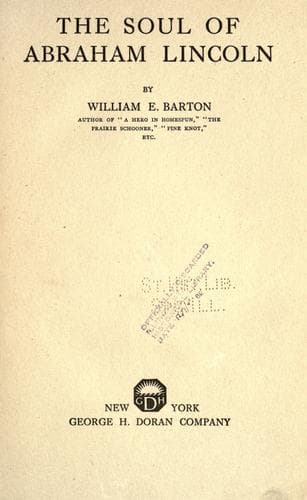
The Soul of Abraham LincolnBarton, William E. (William Eleazar)
Religion
The Soul of Abraham Lincoln
Barton, William E. (William Eleazar)
Lincoln, Abraham, 1809-1865 -- Religion; Presidents -- United States -- Biography
It is quite otherwise with _Vestiges of the Natural History of
Creation_. It was widely circulated, and copies of even the older
editions are not impossible to obtain. It can be purchased, new, at
very small cost.[45] But most of the editions that the reader will be
likely to find, if he seeks for them, are later than the one which
influenced Lincoln, and contain more or less of supplementary matter.
Before passing to another subject, it will be well to say a further
word about this book, for a fuller discussion of which one may go to
Andrew D. White's _Conflict of Science with Theology_ and other learned
works.
The author of this book was Robert Chambers,[46] one of the famous firm
of publishers, and himself an author of note. He was born in Peebles,
Scotland, July 10, 1802, and died at St. Andrews, March 17, 1871. He
was an author as well as publisher of books. He published this book
anonymously, and its authorship was not known for forty years. In 1884,
thirteen years after his death, his name appeared for the first time
upon the title page of a new edition.
It was, in the author's own phrase, "the first attempt to connect the
natural sciences with the history of creation."
From it Lincoln learned geology and comparative biology. In it he
found not only studies of the rocks, but also of the prenatal life of
man, as related in its successive stages to corresponding types in the
geological world. It was, in a word, an introduction to Darwin, which
appeared many years later.
That many ministers denounced it as contradictory to the Bible we
know, and the author anticipated this, nor is this a matter which gives
us present concern. Some ministers believed it, and others, still
unconvinced, read it with an open mind and waited for more light.
The important thing for us to know and clearly recognize is that in
this book Abraham Lincoln not only learned what Herndon considers, and
we are justified in considering, the essential theory of evolution, but
he learned that such a view of creation is consistent with faith in God
and the Bible.
We shall not find it possible to overestimate the importance of this
discovery. Abraham Lincoln wrought out his philosophy of creation,
his scheme of cause and effect, his theory of the processes of nature
and life, under influences not atheistic nor hostile to religion, but
distinctly favorable to it. He learned of evolution, and was convinced
of its truth, from a book whose spirit and purpose was to present the
view in harmony with the Christian faith.
Public-domain text, read in full here on John Shaqi.
Reviews
Reviews
No reviews yet
Be the first to share your thoughts on this work.
Elsewhere in the archive
Join the Discussion
Join the discussion
Sign in to leave a comment or review.
Sign InorCreate an account