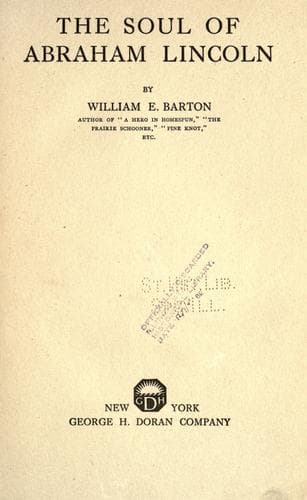
The Soul of Abraham LincolnBarton, William E. (William Eleazar)
Religion
The Soul of Abraham Lincoln
Barton, William E. (William Eleazar)
Lincoln, Abraham, 1809-1865 -- Religion; Presidents -- United States -- Biography
"I would not slight this wondrous world. I love its day and night:
its flowers and its fruits are dear to me. I would not willfully lose
sight of a departing cloud. Every year opens new beauty in a star,
or in a purple gentian fringed with loveliness. The laws, too, of
matter seem more wonderful, the more I study them, in the whirling
eddies of the dust, in the curious shells of former life buried by
thousands in a grain of chalk, or in the shining diagrams of light
above my head. Even the ugly becomes beautiful when truly seen. I
see the jewel in the bunchy toad. The more I live, the more I love
this lovely world,--feel more its Author in each little thing, in all
that is great. But yet I feel my immortality the more. In childhood
the consciousness of immortal life buds forth feeble, though full of
promise. In the man it unfolds its fragrant petals, his most celestial
flower, to mature its seed throughout eternity. The prospect of that
everlasting life, the perfect justice yet to come, the infinite
progress before us, cheer and comfort the heart. Sad and disappointed,
full of self-reproach, we shall not be so forever. The light of heaven
breaks upon the night of trial, sorrow, sin: the somber clouds which
overhung the east, grown purple now, tell us the dawn of heaven is
coming in. Our faces, gleamed on by that, smile in the new-born glow.
We are beguiled of our sadness before we are aware. The certainty
of this provokes us to patience, it forbids us to be slothfully
sorrowful. It calls us to be up and doing. The thought that all will
at last be right with the slave, the poor, the weak, and the wicked,
inspires us with zeal to work for them here, and make it all right for
them even now."--THEODORE PARKER: _Immortality_, pp. 23-24.
It is affirmed that Lincoln was an infidel, believing essentially the
same as Theodore Parker: and he himself expressed such admiration
for and accord with the utterances of Parker which he knew that the
statement is partly true. These two quotations, from two of the most
easily accessible of Parker's discourses, represent the kind of
teaching which Lincoln assimilated from Theodore Parker and show us
what kind of infidelity Lincoln learned from him.
When Lincoln turned to the most widely circulated of Channing's
discourses, he read such utterances as these:
"We regard the Scriptures as the records of God's successive
revelations to mankind, and particularly of the last and most perfect
revelation of His will by Jesus Christ. Whatever doctrines seem to us
to be clearly taught in the Scriptures, we receive without reserve or
exception. We do not, however, attach equal importance to all the
books in this collection.
Public-domain text, read in full here on John Shaqi.
Reviews
Reviews
No reviews yet
Be the first to share your thoughts on this work.
Elsewhere in the archive
Join the Discussion
Join the discussion
Sign in to leave a comment or review.
Sign InorCreate an account