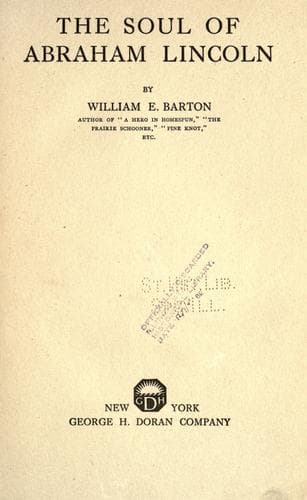
The Soul of Abraham LincolnBarton, William E. (William Eleazar)
Religion
The Soul of Abraham Lincoln
Barton, William E. (William Eleazar)
Lincoln, Abraham, 1809-1865 -- Religion; Presidents -- United States -- Biography
"Our leading principle in interpreting Scripture is this, that the
Bible is a book written for men, in the language of men, and that its
meaning is to be sought in the same manner as that of other books. We
believe that God, when He speaks to the human race, conforms, if we
may so say, to the established rules of speaking and writing. How else
would the Scriptures avail us more than if communicated in an unknown
tongue?
"If God be infinitely wise, He cannot sport with the understandings of
His creatures. A wise teacher discovers his wisdom in adapting himself
to the capacities of his pupils, not in perplexing them with what is
unintelligible, not in distressing them with apparent contradictions,
not in filling them with a skeptical distrust of their own powers. An
infinitely wise teacher, who knows the precise extent of our minds,
and the best method of enlightening them, will surpass all other
instructors in bringing down truth to our apprehension, and in showing
its loveliness and harmony. We ought, indeed, to expect occasional
obscurity in such a book as the Bible, which was written for past and
future ages, as well as for the present. But God's wisdom is a pledge,
that whatever is necessary for _us_, and necessary for salvation,
is revealed too plainly to be mistaken, and too consistently to be
questioned, by a sound and upright mind. It is not the mark of wisdom
to use an unintelligible phraseology, to communicate what is above
our capacities, to confuse and unsettle the intellect by appearances
of contradiction. We honor our heavenly teacher too much to ascribe
to Him such a revelation. A revelation is a gift of light. It cannot
thicken our darkness, and multiply our perplexities.
"We believe, too, that God is just; but we never forget that His
justice is the justice of a good being, dwelling in the same mind,
and acting in harmony with perfect benevolence. By this attribute, we
understand God's infinite regard to virtue or moral worth, expressed
in a moral government; that is, in giving excellent and equitable
laws, and in conferring such rewards and inflicting such punishments,
as are best fitted to secure their observance. God's justice has for
its end the highest virtue of the creation, and it punishes for this
end alone, and thus it coincides with benevolence; for virtue and
happiness, though not the same, are inseparably conjoined.
Public-domain text, read in full here on John Shaqi.
Reviews
Reviews
No reviews yet
Be the first to share your thoughts on this work.
Elsewhere in the archive
Join the Discussion
Join the discussion
Sign in to leave a comment or review.
Sign InorCreate an account