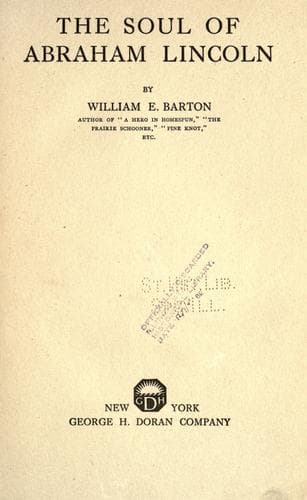
The Soul of Abraham LincolnBarton, William E. (William Eleazar)
Religion
The Soul of Abraham Lincoln
Barton, William E. (William Eleazar)
Lincoln, Abraham, 1809-1865 -- Religion; Presidents -- United States -- Biography
The author of this work is not a Unitarian, and he is ready, on any
proper occasion, to define to anyone who has a right to know, his own
opinions in contradistinction from those of the Unitarian churches. But
his loyalty to his own convictions lays upon him no obligation to be
unfair to men who hold opinions other than his own. It is to be noted
that it is Mr. Herndon, and not some bigoted exponent of orthodoxy,
who calls Theodore Parker an infidel. The present writer holds no
such opinion of Parker, nor yet of Channing. On the contrary, he is
of opinion that their writings were beneficial to Abraham Lincoln,
as helping him to define some of his own views constructively and
reverently. While Beecher or Bushnell might have done it as well or
better, it was not their books which Jesse Fell gave to Lincoln; and
Lincoln used what he had. To say that Lincoln's views were like those
of Parker or Channing is to affirm that Lincoln was not an infidel, but
a Christian.
Was Lincoln, then, a Unitarian?
No. Of Unitarianism he knew nothing, so far as we are informed. He knew
the views of certain Unitarians, and these assisted him at important
points in defining certain aspects of his faith.
There have been rumors that Mr. Lincoln did come into actual contact
with organized Unitarianism. I have been interested in inquiring
whether this was true. During the Billy Sunday meetings in Paterson,
New Jersey, in 1916, the Unitarians opened a booth there for the
distribution of their literature, and there were certain communications
in the local press resulting from the counter-irritation of those
meetings. Among these was one in the Paterson _Guardian_, signed
"Once-in-Awhile." It said:
"The following is, in part, a sketch of my own youthful experience,
together with a statement of facts that relate to others who long
since have passed on.
Public-domain text, read in full here on John Shaqi.
Reviews
Reviews
No reviews yet
Be the first to share your thoughts on this work.
Elsewhere in the archive
Join the Discussion
Join the discussion
Sign in to leave a comment or review.
Sign InorCreate an account