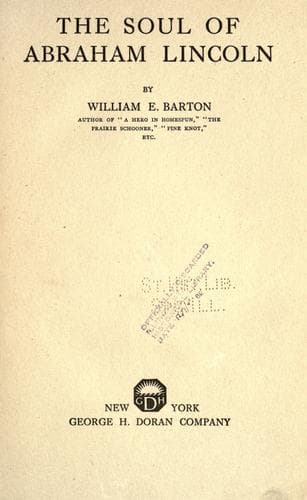
The Soul of Abraham LincolnBarton, William E. (William Eleazar)
Religion
The Soul of Abraham Lincoln
Barton, William E. (William Eleazar)
Lincoln, Abraham, 1809-1865 -- Religion; Presidents -- United States -- Biography
"God's justice, thus viewed, appears to us to be in perfect harmony
with His mercy. According to the prevalent systems of theology, these
attributes are so discordant and jarring, that to reconcile them is
the hardest task, and the most wonderful achievement, of infinite
wisdom. To us they seem to be intimate friends, always at peace,
breathing the same spirit, and seeking the same end. By God's mercy,
we understand not a blind, instinctive compassion, which forgives
without reflection, and without regard to the interests of virtue.
This, we acknowledge, would be incompatible with justice, and also
with enlightened benevolence. God's mercy, as we understand it,
desires strongly the happiness of the guilty, but only through their
penitence."--W. E. CHANNING: Baltimore Discourse of 1819, _Passim_.
"Inward sanctity, pure love, disinterested attachment to God and man,
obedience of heart and life, sincere excellence of character, this
is the one thing needful, this the essential thing in religion; and
all things else, ministers, churches, ordinances, places of worship,
all are but means, helps, secondary influences, and utterly worthless
when separated from this. To imagine that God regards any thing but
this, that He looks at any thing but the heart, is to dishonor Him,
to express a mournful insensibility to His pure character. Goodness,
purity, virtue, this is the only distinction in God's sight. This is
intrinsically, essentially, everlastingly, and by its own nature,
lovely, beautiful, glorious, divine. It owes nothing to time, to
circumstance to outward connections. It shines by its own light. It is
the sun of the spiritual universe. It is God himself dwelling in the
human soul. Can any man think lightly of it, because it has not grown
up in a certain church, or exalt any church above it? My friends,
one of the grandest truths of religion is the supreme importance of
character, of virtue, of that divine spirit which shone out in Christ.
The grand heresy is, to substitute any thing for this, whether creed,
or form, or church."--W. E. CHANNING: _Discourse on the Church_, pp.
23-24.
If Lincoln was made an infidel or confirmed in his infidelity by his
reading of William Ellery Channing, the foregoing is a reasonable
sample of the quality of his infidelity: for these are not only
characteristic utterances of Channing: they are among the utterances
which Lincoln was most certain to have had thrust into his hand, and
most likely to have read and to have approved.
Public-domain text, read in full here on John Shaqi.
Reviews
Reviews
No reviews yet
Be the first to share your thoughts on this work.
Elsewhere in the archive
Join the Discussion
Join the discussion
Sign in to leave a comment or review.
Sign InorCreate an account