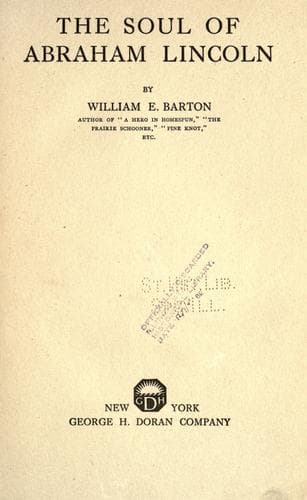
The Soul of Abraham LincolnBarton, William E. (William Eleazar)
Religion
The Soul of Abraham Lincoln
Barton, William E. (William Eleazar)
Lincoln, Abraham, 1809-1865 -- Religion; Presidents -- United States -- Biography
"In the Presidential campaign of 1864 there were sullen whisperings
that Mr. Lincoln had no religious opinions nor any interest in
churches or Christian institutions. They faded away with other libels,
never to be renewed until after his death. One of his biographers,
who calls himself the 'friend and partner for twenty years' of the
deceased President, has since published what he calls a history of his
life, in which he revives the worst of these rumors, with additions
which, if true, would destroy much of the world's respect for Mr.
Lincoln. He asserts that his 'friend and partner' was 'an infidel
verging towards atheism.' Others have disseminated these charges
in lectures and fugitive sketches so industriously that they have
produced upon strangers some impression of their truth. The excuse
alleged is, their desire to present Mr. Lincoln to the world 'just as
he was.' Their real purpose is to present him just as they would have
him to be, as much as possible like themselves.
"It is a trait of the infidel to parade his unbelief before the
public, and he thinks something gained to himself when he can show
that others are equally deficient in moral qualities. But these
writers have attempted too much. Their principal charge of infidelity,
tinged with atheism, is so completely at variance with all our
knowledge of his opinions that its origin must be attributed to malice
or to a defective mental constitution.
"His sincerity and candor were conspicuous qualities of Mr. Lincoln's
mind. Deception was a vice in which he had neither experience nor
skill. All who were admitted to his intimacy will agree that he was
incapable of professing opinions which he did not entertain. When we
find him at the moment of leaving his home for Washington, surrounded
by his neighbors of a quarter of a century, taking Washington for
his exemplar, whose success he ascribed 'to the aid of that Divine
Providence upon which he at all times relied,' and publicly declaring
that he, himself, 'placed his whole trust in the same Almighty Being,
and the prayers of Christian men and women'; when, not once or twice,
but on all proper, and more than a score of subsequent occasions, he
avowed his faith in an Omnipotent Ruler, who will judge the world in
righteousness--in the Bible as the inspired record of His history and
His law; when with equal constancy he thanked Almighty God for, and
declared his interest in, Christian institutions and influences as the
appointed means for his effective service, we may assert that we know
that he was neither an atheist nor an infidel, but, on the contrary, a
sincere believer in the fundamental doctrines of the Christian faith.
In fact, he believed so confidently that the Almighty was making use
of the war, of himself, and other instrumentalities in working out
some great design for the benefit of humanity, and his belief that he
himself was directed by the same Omniscient Power was expressed with
Public-domain text, read in full here on John Shaqi.
Reviews
Reviews
No reviews yet
Be the first to share your thoughts on this work.
Elsewhere in the archive
Join the Discussion
Join the discussion
Sign in to leave a comment or review.
Sign InorCreate an account