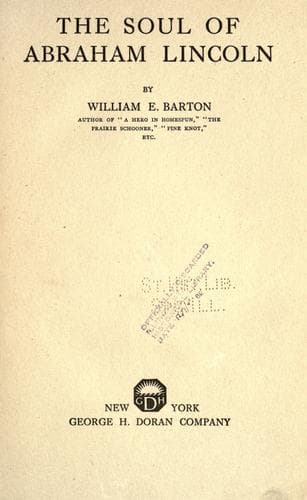
The Soul of Abraham LincolnBarton, William E. (William Eleazar)
Religion
The Soul of Abraham Lincoln
Barton, William E. (William Eleazar)
Lincoln, Abraham, 1809-1865 -- Religion; Presidents -- United States -- Biography
such frankness and frequency, that it attracted attention, and was
criticized by some as verging towards superstition. His public life
was a continuous service of God and his fellow-man, controlled and
guided by the golden rule, in which there was no hiatus of unbelief or
incredulity.
"Here I might well stop, and submit that these charges do not deserve
any further consideration. But I know how false they are, and I may
be excused if I record one of my sources of knowledge.
"The emphatic statement made by the President to Mr. Fessenden,
that he was called to the Presidency by a Power higher than human
authority, I have already mentioned. His calm serenity at times
when others were so anxious, his confidence that his own judgment
was directed by the Almighty, so impressed me that, when I next had
the opportunity, at some risk of giving offense, I ventured to ask
him directly how far he believed the Almighty actually directed our
national affairs. There was a considerable pause before he spoke, and
when he did speak, what he said was more in the nature of a monologue
than an answer to my inquiry:
"'That the Almighty does make use of human agencies, and directly
intervenes in human affairs, is,' he said, 'one of the plainest
evidences of His direction, so many instances when I have been
controlled by some other power than my own will, that I cannot doubt
that this power comes from above. I frequently see my way clear to
a decision when I am conscious that I have no sufficient facts upon
which to found it. But I cannot recall one instance in which I have
followed my own judgment, founded upon such a decision, where the
results were unsatisfactory; whereas, in almost every instance where I
have yielded to the views of others, I have had occasion to regret it.
I am satisfied that when the Almighty wants me to do or not to do a
particular thing, He finds a way of letting me know it. I am confident
that it is His design to restore the Union. He will do it in His own
good time. We should obey and not oppose His will.'
"'You speak with such confidence,' I said, 'that I would like to know
how your knowledge that God acts directly upon human affairs compares
in certainty with your knowledge of a fact apparent to the senses--for
example, the fact that we are at this moment here in this room.'
"'One is as certain as the other,' he answered, 'although the
conclusions are reached by different processes. I know by my senses
that the movements of the world are those of an infinitely powerful
machine, which runs for ages without a variation. A man who can put
two ideas together knows that such a machine requires an infinitely
powerful maker and governor: man's nature is such that he cannot take
in the machine and keep out the maker. This maker is God--infinite
in wisdom as well as in power. Would we be any more certain if we saw
Him?'
Public-domain text, read in full here on John Shaqi.
Reviews
Reviews
No reviews yet
Be the first to share your thoughts on this work.
Elsewhere in the archive
Join the Discussion
Join the discussion
Sign in to leave a comment or review.
Sign InorCreate an account