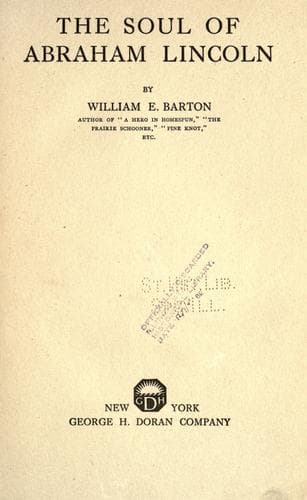
The Soul of Abraham LincolnBarton, William E. (William Eleazar)
Religion
The Soul of Abraham Lincoln
Barton, William E. (William Eleazar)
Lincoln, Abraham, 1809-1865 -- Religion; Presidents -- United States -- Biography
Both President and Mrs. Lincoln were superstitious. They believed in
dreams and signs, he more in dreams and she more in signs. When Mrs.
Lincoln was away from him for a little time, visiting in Philadelphia
in 1863, and Tad with her, Lincoln thought it sufficiently important to
telegraph, lest the mail should be too slow, and sent her this message:
"Executive Mansion,
"Washington, June 9, 1863.
"MRS. LINCOLN,
"Philadelphia, Pa.
"Think you better put Tad's pistol away. I had an ugly dream about him.
"A. Lincoln."
--Quoted in facsimile in _Harper's Magazine_ for February, 1897;
_Lincoln's Home Life in the White House_, by Leslie J. Perry.
In Lamon's book of _Recollections_, published in 1895, a very different
book from his Life of Lincoln, he devotes an entire chapter to
Lincoln's dreams and presentiments. He relates the story of the dream
which Lincoln had not long before his assassination wherein he saw the
East Room of the White House containing a catafalque with the body of
an assassinated man lying upon it. Lincoln tried to remove himself from
the shadow of this dream by recalling a story of life in Indiana, but
could not shake off the gloom of it. Lamon says:
"He was no dabbler in divination, astrology, horoscopy, prophecy,
ghostly lore, or witcheries of any sort.... The moving power of
dreams and visions of an extraordinary character he ascribed,
as did the Patriarchs of old, to the Almighty Intelligence that
governs the universe, their processes conforming strictly to natural
laws."--_Recollections_, p. 120.
In his Life of Lincoln, Lamon tells the story of the dream which
Lincoln had late in the year 1860, when resting upon a lounge in his
chamber he saw his figure reflected in a mirror opposite with two
images, one of them a little paler than the other. It worried Lincoln,
and he told his wife about it. She thought it was "a sign that Lincoln
was to be elected for a second term and that the paleness of one of
the faces indicated that he would not see life through the last term"
(p. 477).
As this optical illusion has been so often printed, and has seemed so
weirdly prophetic of the event which followed, it may be well to quote
an explanation of the incident from an address by Dr. Erastus Eugene
Holt, of Portland, Maine:
Public-domain text, read in full here on John Shaqi.
Reviews
Reviews
No reviews yet
Be the first to share your thoughts on this work.
Elsewhere in the archive
Join the Discussion
Join the discussion
Sign in to leave a comment or review.
Sign InorCreate an account