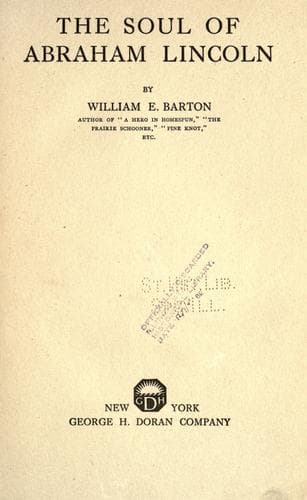
The Soul of Abraham LincolnBarton, William E. (William Eleazar)
Religion
The Soul of Abraham Lincoln
Barton, William E. (William Eleazar)
Lincoln, Abraham, 1809-1865 -- Religion; Presidents -- United States -- Biography
"As he lay there upon the couch, every muscle became relaxed as
never before.... In this relaxed condition, in a pensive mood and
in an effort to recuperate the energies of a wearied mind, his eyes
fell upon the mirror in which he could see himself at full length,
reclining upon the couch. All the muscles that direct, control, and
keep the two eyes together were relaxed; the eyes were allowed to
separate, and each eye saw a separate and distinct image by itself.
The relaxation was so complete, for the time being, that the two eyes
were not brought together, as is usual by the action of converging
muscles, hence the counterfeit presentiment of himself. He would have
seen two images of anything else had he looked for them, but he was
so startled by the ghostly appearance that he felt 'a little pang as
though something uncomfortable had happened,' and obtained but little
rest. What a solace to his wearied mind it would have been if someone
could have explained this illusion upon rational grounds!"--Address
at Portland, Maine, February 12, 1901, reprinted by William Abbatt,
Tarrytown, N. Y., 1916.
Other incidents which relate to Mr. Lincoln's faith in dreams,
including one that is said to have occurred on the night preceding his
assassination, are well known, and need not be repeated here in detail.
It is not worth while to seek to evade or minimize the element of
superstition in Lincoln's life, nor to ask to explain away any part
of it. Dr. Johnson admits it in general terms, but makes little of
concrete instances:
"The claim that there was more or less of superstition in his nature,
and that he was greatly affected by his dreams, is not to be disputed.
Many devout Christians today are equally superstitious, and, also,
are greatly affected by their dreams. Lincoln grew in an atmosphere
saturated with all kinds of superstitious beliefs. It is not strange
that some of it should cling to him all his life, just as it was with
Garfield, Blaine, and others.
"In 1831, then a young man of twenty-two, Lincoln made his second trip
to New Orleans. It was then that he visited a Voodoo fortune teller,
that is so important in the eyes of certain people. This, doubtless,
was out of mere curiosity, for it was his second visit to a city. This
no more indicates a belief in 'spiritualism' than does the fact that
a few days before he started on this trip he attended an exhibition
given by a traveling juggler, and allowed the magician to cook eggs in
his low-crowned, broad-rimmed hat."--_Lincoln the Christian_, p. 29.
I do not agree with this. Superstition was inherent in the life of the
backwoods, and Lincoln had his full share of it. Superstition is very
tenacious, and people who think that they have outgrown it nearly all
possess it. "I was always superstitious," wrote Lincoln to Joshua F.
Speed on July 4, 1842. He never ceased to be superstitious.
Public-domain text, read in full here on John Shaqi.
Reviews
Reviews
No reviews yet
Be the first to share your thoughts on this work.
Elsewhere in the archive
Join the Discussion
Join the discussion
Sign in to leave a comment or review.
Sign InorCreate an account