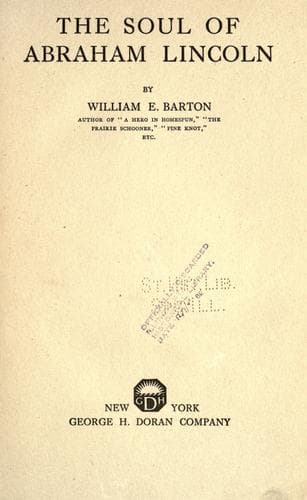
The Soul of Abraham LincolnBarton, William E. (William Eleazar)
Religion
The Soul of Abraham Lincoln
Barton, William E. (William Eleazar)
Lincoln, Abraham, 1809-1865 -- Religion; Presidents -- United States -- Biography
Lincoln lacked some of the finer feelings. He combined a deep personal
sympathy for anything which he could visualize with a rather strange
mental obtuseness toward things remote or abstract. Darwin, who was
born in the same year, had an early love of poetry and music. How
these tastes became atrophied in his concentration of thought upon
matters relating to the natural sciences was confessed and mourned by
him, and has often been commented upon by others. The time came to him
when music and poetry gave him physical nausea. Lincoln never had an
appreciation or love of anything very fine either in poetry or music.
At a time when he was being considered for President he could sit in a
stage coach playing "Yankee Doodle" on the mouth-organ[55] and playing
it badly, but he had no fine musical or poetic taste.
Not long before his assassination his sister-in-law, Mrs. Edwards,
visited at the White House, and he accompanied her one evening to the
conservatory. She greatly admired the rare exotics which she there
beheld for the first time, and Lincoln vainly strove to share her
enthusiasm but confessed to her that something had been left out of his
nature. Such things seemed to make no appeal to him.
Of Lincoln's lack in matters involving the finer feelings we have
abundant testimony not only in the pages of Lamon and Herndon, but in
other intimate sketches of his life in Illinois, as, for example, in
Whitney's _With Lincoln on the Circuit_,[56] and especially in his
article in the _Arena_ in April, 1898. There were aspects of religion
which did not make as strong an appeal to Abraham Lincoln as they would
have made but for this blind spot in his nature.
It is not the purpose of this book to go in any detail into Mr.
Lincoln's love affairs; but if any further illustration were desired of
this point of which we are speaking, it could be found very painfully
in his relations with Miss Owens, and his letter to Mrs. Browning.
Reference has been made to a certain lack of good taste which Lincoln
sometimes manifested, and of which the reminiscences of Lamon, Herndon,
Whitney, and others of his associates have given us sufficient
example. But it was not always so with Lincoln. There was in him an
innate courtesy, an intuitive sympathy, an ability to adapt himself
to another's point of view, which gave him the essential quality of
a gentleman. Fred Douglass said of him that Mr. Lincoln was the only
white man with whom he ever talked for an hour who did not in some way
remind him that he was a negro. That same fine feeling showed itself in
many ways.
Public-domain text, read in full here on John Shaqi.
Reviews
Reviews
No reviews yet
Be the first to share your thoughts on this work.
Elsewhere in the archive
Join the Discussion
Join the discussion
Sign in to leave a comment or review.
Sign InorCreate an account