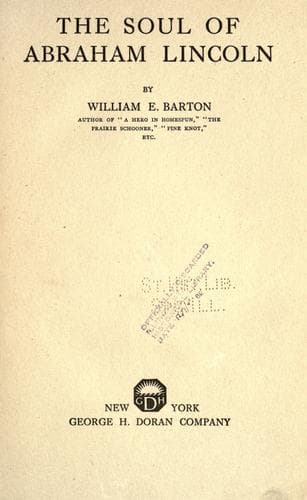
The Soul of Abraham LincolnBarton, William E. (William Eleazar)
Religion
The Soul of Abraham Lincoln
Barton, William E. (William Eleazar)
Lincoln, Abraham, 1809-1865 -- Religion; Presidents -- United States -- Biography
Mr. Henry B. Rankin, who wrote his _Reminiscences_ in 1916, states
that he was a boy in Lincoln's office and his parents knew Lincoln
intimately during his years of struggle in New Salem. Mr. Rankin's
recollection of a conversation which Lincoln had with Mr. Rankin's
mother indicates that Lincoln had some such feeling as far back as
his New Salem days. The Rankin family were warm friends of Peter
Cartwright, whom they called Uncle Peter, and also of Mr. Lincoln.
Mrs. Rankin asked him concerning the rumor that he was an infidel, and
Lincoln denied it; but being pressed to explain why he did not then
confess his Christian faith, he gave to her much the answer which in
later years he gave to Mr. Deming and to Dr. Gurley (_Reminiscences of
Lincoln_, pp. 324-26).
I think, then, we are compelled to accept this threefold testimony
as establishing beyond any reasonable doubt the answer that Lincoln
himself gave to the question, why he did not unite with the Church. It
is a great pity that he was not brought into contact with some form
of organized Christianity, orthodox and constructive in its essential
teachings, but with conditions of church membership as broad as those
of entrance into the kingdom of heaven. Churches have learned a little
better than they understood in 1846 that a church creed should be
a testimony and not a test; that it is entirely consistent with the
organization and ideal of a thoroughly orthodox church to receive into
its membership any and every person who loves God and his fellow-man
even though he doubts thirty-eight of the thirty-nine articles of the
creed and is more or less uncertain about the other one.
But we cannot consider the question of Lincoln's possible church
membership and his failure to acquire it without asking whether the
fault was wholly that of the churches. Other men beside Abraham Lincoln
were more liberal than the churches, including old Mentor Graham, but
were able to find a home there; though Graham was ultimately turned
out of the so-called "hardshell" church for his warm advocacy of the
principles of temperance. Some share of the responsibility for his
failure to unite with the Church must belong to Lincoln himself.
It is a hazardous thing to suggest any element short of perfection in
the life or thought of any popular hero. Nevertheless let us remind
ourselves that Lincoln had the defects of his qualities.
Public-domain text, read in full here on John Shaqi.
Reviews
Reviews
No reviews yet
Be the first to share your thoughts on this work.
Elsewhere in the archive
Join the Discussion
Join the discussion
Sign in to leave a comment or review.
Sign InorCreate an account