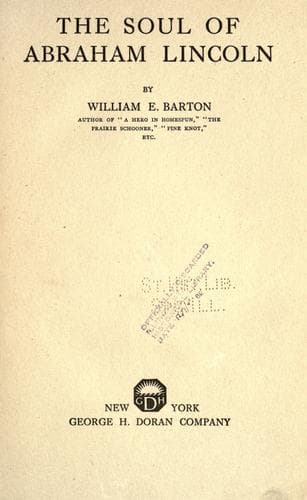
The Soul of Abraham LincolnBarton, William E. (William Eleazar)
Religion
The Soul of Abraham Lincoln
Barton, William E. (William Eleazar)
Lincoln, Abraham, 1809-1865 -- Religion; Presidents -- United States -- Biography
It is my firm conviction that, after the death of Eddie, Lincoln was
profoundly stirred in his own spiritual life; that the arguments of Dr.
Smith went far toward answering the arguments of Paine, Volney, and his
freethinking friends; that bereavement and spiritual comfort had done
their work of grace; that the desire for a home more truly united in
its religious relations and spiritual sympathies made a strong appeal
to him; and that the atmosphere of the revival seemed to make it easy
and natural for him to enter the church with Mrs. Lincoln. But, though
a Calvinist in his early training, he was not ready to accept Calvinism
as a complete and articulated system as presented in the Westminster
Confession and in the preaching of Dr. Smith.
He wavered. Whether he left town to avoid pressure to attend the
meeting of the Session at which his wife made her application for
church membership, we do not know. It is not improbable. Certainly
if his absence had been unavoidable he could have joined at the next
opportunity. I think that he did not join because he was still in
some measure of intellectual uncertainty with reference to doctrinal
matters. I am only sorry that someone did not tell him that these were
no sufficient reasons for his declining to unite with the church.
It would be possible to carry this study further, but it is not
necessary. An explanation of Lincoln's failure to unite with a
Christian church in that time of bitter sectarianism when to have
joined one church would have made him a target for criticism from
others and when his mind was intent rather upon the application of his
Christian principles than the proclamation of his religious opinions,
is partly to be attributed to the faults of the churches; but a portion
of the explanation is to be found also in qualities inherent in the
life of Abraham Lincoln.
CHAPTER XXII
THE CONSTRUCTIVE ARGUMENT
WE are ready now to undertake the difficult task of determining with
some approach to certainty the essential content and character of
Abraham Lincoln's religious belief.
We must not be surprised if we find ourselves unable to construct a
perfectly symmetrical and consistent confession of faith. The material
is much more abundant and explicit and much better attested in some
departments than in others. Not only so, but we must never forget the
mighty elements of contradiction in Lincoln's personality.
Public-domain text, read in full here on John Shaqi.
Reviews
Reviews
No reviews yet
Be the first to share your thoughts on this work.
Elsewhere in the archive
Join the Discussion
Join the discussion
Sign in to leave a comment or review.
Sign InorCreate an account