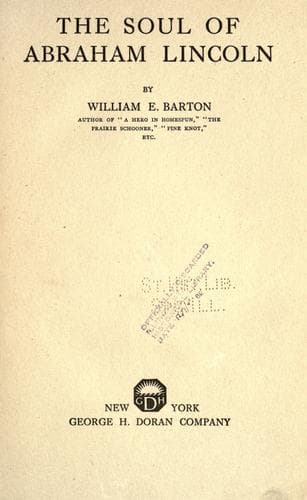
The Soul of Abraham LincolnBarton, William E. (William Eleazar)
Religion
The Soul of Abraham Lincoln
Barton, William E. (William Eleazar)
Lincoln, Abraham, 1809-1865 -- Religion; Presidents -- United States -- Biography
Mediocre men have this in their favor, that it is relatively easy to
classify them. Not only may they be readily assigned to their several
occupations, and conveniently pigeon-holed as butchers, bakers, and
candlestick makers, but it is a comparatively simple task to group
them under single adjectives, as good and bad, black and white, tall
and short, fat and lean, old and young, intelligent and stupid.
The process is less easy with really great men. There is always an
admirable element of human inconsistency in men of large mold which
would be intolerable in lesser personalities. It has been truly said
that no man becomes really great and influential who is not a good
subject for caricature. The sublime is own sister to the ridiculous.
Genius is next akin to insanity. The men who do really great things
are a perpetual puzzle to those who possess only commonplace standards
of classification. A commonplace villain is a villain, first, last,
and all the time; but a villain like Milton's Satan, Napoleon, or the
late German Kaiser is so great a villain as to be half a hero. The two
hundred seventy-six dripping men who struggled through the surf at
Malta one stormy morning rather more than eighteen hundred years ago
and gathered shivering round the fire, were quickly classified, for
the most part, into four convenient companies, of sailors, soldiers,
passengers, and prisoners; but when one of them shook off a viper into
the fire and showed no sign of hurt, it was quite certain that he was
either a murderer or a god. Opinions might differ and did differ as to
which of the two extremes might properly be claimed for him, but no one
proposed to find a place for him in middle ground.
The strength of great men lies in their possession and their
counterpoise of opposing qualities. Over against the monotonous
uniformity, the stupid consistency, of those common people whom Lincoln
said God must love because He made so many of them, this quality
displays itself as a peculiar possession of genius. Now and then it is
given to a great man sufficiently so to subordinate the inconsistencies
without which real greatness could not exist as to incarnate some
outstanding principle of which he becomes the exponent. Abraham
Lincoln did this; and the world, or that small part of the world which
can lay claim to any considerable measure of moral discernment, has
redefined its conception of certain high qualities, its measure of the
moral significance of certain notable achievements, in terms of his
personality. This process is highly desirable as well as inevitable;
but the elements of inconsistency are not thereby removed from the
character itself. Of him we might say:
"_His life was gentle, and the elements
So mixed in him, that Nature might stand up,
And say to all the world: This was a man!_"
--_Julius Caesar, V, 5._
Public-domain text, read in full here on John Shaqi.
Reviews
Reviews
No reviews yet
Be the first to share your thoughts on this work.
Elsewhere in the archive
Join the Discussion
Join the discussion
Sign in to leave a comment or review.
Sign InorCreate an account