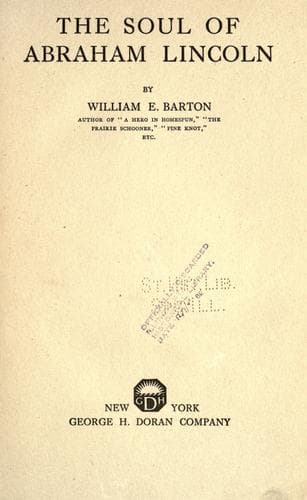
The Soul of Abraham LincolnBarton, William E. (William Eleazar)
Religion
The Soul of Abraham Lincoln
Barton, William E. (William Eleazar)
Lincoln, Abraham, 1809-1865 -- Religion; Presidents -- United States -- Biography
Herndon did not accept the pork and malaria theories. He said that all
such theories must give way to facts, and he dealt with facts. The men
of the frontier had the best meat in the world, "venison, bear, turkey,
and of course some hog."
"You ask me if I ever saw in this great wild west many men of
Lincoln's type, and to which I answer, Yes. The first settlers of
central and southern Illinois were men of that type. They came from
the limestone regions of Virginia, Kentucky, and Tennessee, and were
men of giant strength, physical force, and by nature mentally strong.
They were original, were individualists. The strong alone from 1818 to
1830 could get here, and the strong alone could survive here.... No
one was like Lincoln, and yet many were of his type.... He was, as
you say, 'a man of extraordinary contrasts.' You would not look for a
well-rounded man in such a description."
Lincoln was, then, as Herndon saw him, and as the world must see him,
a legitimate product of his environment. Herndon had read Buckle and
Spencer and Darwin, and was a thoroughgoing believer in evolution, as
was Lincoln, from a far narrower reading, but a very thoughtful study
of _Vestiges of Creation_.
Physically, Lincoln was akin to the strong pioneers of early Illinois,
and it was not difficult to find each several trait of Lincoln
reduplicated in many of them. But Lincoln himself was never duplicated.
He was a product of his environment, but he was also an evolution which
in terms of an individual personality went beyond environment, and was
still going forward when death came to him.
This evolution of Lincoln, the spiritual Lincoln, as portrayed in these
letters to a sculptor, who must not be permitted to forget, if he was
in danger of forgetting, that the real man Lincoln had in him more than
his bodily measurements could portray, is one of the most suggestive
studies disclosed by Herndon, and it is sound, both as approached from
the standpoint of science, and as considered in the personal study of
Lincoln in his growth from year to year.
Like St. Paul, Lincoln had a warfare in his members. He was an
embodiment of forces mutually antagonistic. He would not have been
the man he was had either of them been lacking, and the growth of
either at the total expense of the other would have given us a man
abnormal, which Mr. Lincoln came perilously near to being. But his real
development was mental and spiritual.
Public-domain text, read in full here on John Shaqi.
Reviews
Reviews
No reviews yet
Be the first to share your thoughts on this work.
Elsewhere in the archive
Join the Discussion
Join the discussion
Sign in to leave a comment or review.
Sign InorCreate an account