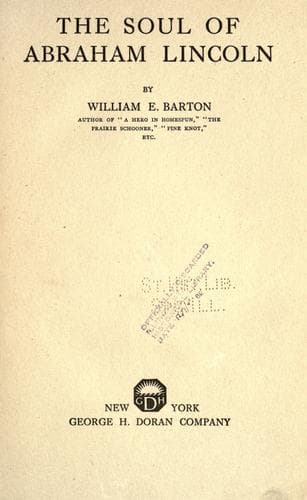
The Soul of Abraham LincolnBarton, William E. (William Eleazar)
Religion
The Soul of Abraham Lincoln
Barton, William E. (William Eleazar)
Lincoln, Abraham, 1809-1865 -- Religion; Presidents -- United States -- Biography
In another place St. Paul says that "The first man is of the earth,
earthy, and the second man is from heaven." It has been assumed without
due warrant that what he had in mind was a contrast between Adam and
Christ, and this view is strengthened by the intrusion of the words
"the Lord" in the authorized English text. But it is quite possible
that St. Paul, even if Adam and Christ were a part of his contrast,
had really in mind the evolution of any man's life; he being himself
in his bodily nature the first man and in the birth and growth of his
higher nature the second and contrasting man. "First is that which is
natural, and after, that which is spiritual."
This was Herndon's thought of Lincoln, as disclosed in these
letters,[63] and it is true of Lincoln. Lincoln was more than an
embodiment of contrasts; the solar system is that, and it is more. In
the solar system the opposing forces do not neutralize each other, but
together hold the earth and planets in their orbits. So it was with
Lincoln. But with him the higher and nobler forces became increasingly
dominant.
Herndon resented it when anyone said that Lincoln had died at the right
time. He believed that, great as Lincoln was, his nobler qualities had
not yet come to their full maturity, and that a longer-lived Lincoln
would have been an even nobler Lincoln. Here are some of the things he
says of him in these letters:
"I said to you once that Mr. Lincoln had not arrived at maturity
in 1865, and I say so now. His blood ran slowly--had low or slow
circulation and consequently a slow build-up. As he had a slow
build-up, so he had a slow development; he grew up like the forest
oak, tough, solid, knotty, gnarled, standing out with power against
the storm, and almost defying the lightning. Hence I conclude that
he had not arrived at his highest development in 1865.... The
convolutions of his brain were long; they did not snap off quickly
like a short, thick man's brain.... The enduring power of Mr.
Lincoln's thought and brain was wonderful. He could sit and think
without food or rest longer than any man I ever saw."
He goes into detail concerning Mr. Lincoln's bodily lethargy and its
effect on body and mind, the sluggishness of all his functions, and
affirms that this must be taken into account in any right estimate of
the man; but that steadily, and the more surely because slowly, his
mind and soul developed and became more and more dominant.
Public-domain text, read in full here on John Shaqi.
Reviews
Reviews
No reviews yet
Be the first to share your thoughts on this work.
Elsewhere in the archive
Join the Discussion
Join the discussion
Sign in to leave a comment or review.
Sign InorCreate an account