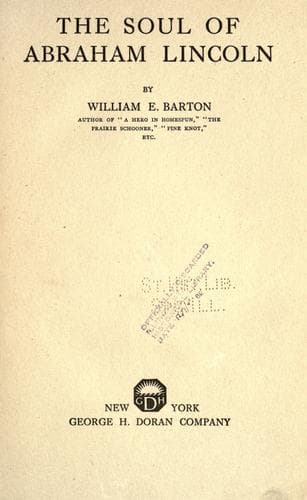
The Soul of Abraham LincolnBarton, William E. (William Eleazar)
Religion
The Soul of Abraham Lincoln
Barton, William E. (William Eleazar)
Lincoln, Abraham, 1809-1865 -- Religion; Presidents -- United States -- Biography
There was an evolution in his apprehension of the ethical implications
of public office. The Lincoln who re-entered politics after the
repeal of the Missouri Compromise was a changed man from the Lincoln
who, with the other members of the "Long Nine," earned by political
log-rolling the severe but not wholly unmerited name applied to them
by one of Illinois' best governors, "spared monuments of popular
wrath." That Lincoln did not in this earlier period commit any
personally dishonorable act is not an argument against the theory
here advocated. He had, in his later political career, a far higher
ideal of political honor, a greatly nobler conception of the dignity
of public office--which he always sought--as a field of popular
service. His political career was an evolution, and it developed nobler
characteristics than that which characterized his earlier political
life.
Lincoln's emancipation policy was an evolution. The successive stages
of that policy were worthily set forth by Paul Selby in an address
before the Historical Society of Chicago.[64] There never was a time
when Abraham Lincoln did not believe slavery to be wrong, but there was
a time when he was not an Abolitionist. The moral aspect of the slavery
question grew in his mind and conscience till he promised his God to
free the slaves.
On Sunday evening, September 7, 1862, a public meeting was held in
Bryan Hall, Chicago, to urge upon the President the desire of Christian
people that he should free the slaves. A petition was circulated, and
was signed by all the Congregational and nearly all the Methodist and
Baptist ministers of that city, courteously requesting the President
to give the matter his earnest attention. The petition was sent
to Washington by the hand of Rev. William W. Patton and Rev. John
Dempster, who met the President by appointment on Saturday afternoon,
September 13, the interview being arranged by Hon. Gideon Welles.
The story of that meeting has often been told in part, with undue
emphasis upon Mr. Lincoln's statement then made that if God had a
message for him on this subject He would be more likely to communicate
it directly to Mr. Lincoln than to others for him. The latest book to
misuse this incident is one just from the press in Great Britain, the
_Short Life of Lincoln_, by Hon. Ralph Shirley, who says:
"Some of the ministers in this deputation even went so far as to
assure him that they had authority in God's name to command him to
emancipate the slaves."
Inasmuch as there were but two of the ministers, and neither of them
assumed any such authority to speak the mind of God, such statements
ought to cease, especially as the true story, from which all these
accounts are garbled, is available for inspection in the files of the
Maryland Historical Society.
Public-domain text, read in full here on John Shaqi.
Reviews
Reviews
No reviews yet
Be the first to share your thoughts on this work.
Elsewhere in the archive
Join the Discussion
Join the discussion
Sign in to leave a comment or review.
Sign InorCreate an account