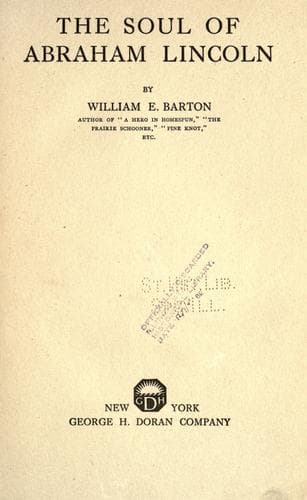
The Soul of Abraham LincolnBarton, William E. (William Eleazar)
Religion
The Soul of Abraham Lincoln
Barton, William E. (William Eleazar)
Lincoln, Abraham, 1809-1865 -- Religion; Presidents -- United States -- Biography
Mr. Lincoln did say to them that he hoped it would not appear
irreverent in him to say that if God were to reveal this duty of his
to others, it was probable that He would reveal it also directly to
Mr. Lincoln. At the beginning of the interview he was guarded; but as
he found common ground with his visitors, he threw first one leg and
then the other over the arm of his chair, and talked to them with the
utmost freedom, and asked them concerning the opinion of ministers and
churches, and assured them that he desired to know the will of God, and
whatever seemed to him to be God's will he would do.
The next week occurred the battle of Antietam, and on Saturday,
September 20, exactly a week after his interview with the Chicago
ministers, Mr. Lincoln called the Cabinet together and read to them
the Emancipation Proclamation, which was signed and published on the
following Monday. We know now that Lincoln had promised God that if
that battle resulted in the success of the Union cause he would issue
the proclamation. We also know that the meeting with the Chicago
ministers was very timely, and gave him an added assurance of moral
support from the churches, if not added confidence in the help of God.
Some time after, Joseph Medill, editor of the Chicago _Tribune_,
returning from Washington, said, "Secretary Stanton told me to say
to those Chicago clergymen who waited on the President about the
Proclamation of Emancipation, that their interview finished the
business. After that there was no manifestation of doubt or talk of
delay. Mr. Lincoln's mind was fully made up."--_Proceedings of the
Maryland Historical Society, Baltimore_, 1888.
Lincoln's literary style was an evolution.[65] His spread-eagle
stump-speeches, with their florid rhetoric and grandiloquent figures
of speech evolved into the calm, dignified, and forceful English of
his maturer years.[66] An able monograph in which this evolution is
traced is cited elsewhere in this volume.[67] That change of style was
the outward and visible sign of an inward and spiritual as well as
intellectual grace.
In like manner Lincoln's religion was an evolution, both in its
intellectual and its spiritual qualities. Up to the time of his
residence in New Salem he had heard only the dogmatic sectarianism of
unlettered preachers, proclaiming a creed which furnished him certain
lifelong tenets but which as a whole he could not accept. At New Salem
he read the negative arguments which confuted the dogmas he had heard,
and perhaps unwittingly made room for a more intelligent faith.
He was deeply impressed by the argument of Dr. Smith in his _The
Christian's Defence_. It was the first time he had heard the Christian
apologetic rationally presented, and it made a lasting impression upon
him without, however, fully satisfying him. He was, however, a much
more religious man when he left Springfield than he was when he came
to it, whether he knew it or not.
Public-domain text, read in full here on John Shaqi.
Reviews
Reviews
No reviews yet
Be the first to share your thoughts on this work.
Elsewhere in the archive
Join the Discussion
Join the discussion
Sign in to leave a comment or review.
Sign InorCreate an account