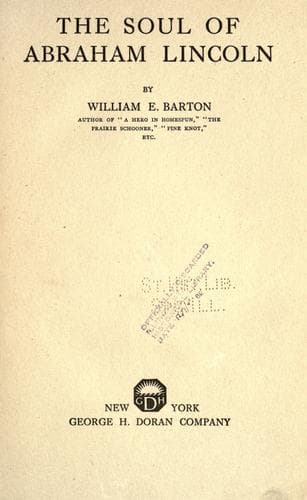
The Soul of Abraham LincolnBarton, William E. (William Eleazar)
Religion
The Soul of Abraham Lincoln
Barton, William E. (William Eleazar)
Lincoln, Abraham, 1809-1865 -- Religion; Presidents -- United States -- Biography
If it were asked, where in such a system as his he found a place
for the forgiveness of sins, the answer would be first that he had
no system, and secondly that he found no place for the doctrine;
but it would then be necessary to add that he found the doctrine,
nevertheless. He had no system. He thought without logical method. But
his thinking was in right lines. He followed simple paths, "blazed"
through technicalities and in quite thorough disregard of them. As
his office desk was in confusion, and he kept a package marked,
"When you don't find it anywhere else, look here," so he had in his
thinking a parcel of unassorted first principles to which he recurred
when he needed them. Forgiveness and law were to him two unreconciled
postulates; but law he had to assume, even though he denied
forgiveness. But if he did not admit belief in forgiveness, he did
believe in mercy, for he himself was merciful, and he believed that he
would be merciful to God if he were God and God were man. Stanton could
argue him down as to the necessity for shooting a soldier who slept on
duty, but Lincoln injected an intuitive, and from Stanton's point of
view, an unreasonable and a certainly unarticulated, element of mercy
that forbade the killing of this particular boy.
His theory of governmental forgiveness was as irreconcilable with his
theory of military discipline as his theory of divine mercy was with
his system of inexorable law. He did not harmonize the contradictions:
he was merciful, and let his system take the consequences, and he
believed in a divine mercy while holding a theory with which the
exercise of mercy was irreconcilable.
To such a mind as that of Abraham Lincoln, it was not necessary to
prove the fact of immortality. If God possessed immortality and
intended it for man, then God would make His decree effective in man.
Adam's fall could not hopelessly lose to man what God designed; and,
whether he accepted for himself or not the theory of the fall and of
redemption, he accepted both in meeting an argument which by reason of
the fall could have deprived man of his birthright of immortality. He
believed in the immortality of the soul.
Did he harmonize that doctrine with the rest of his creed? Probably
not. He was no theologian, in the strict and formal sense, no logician.
He reasoned on the basis of very simple and elementary principles,
whose lines of direction were determined by the early Calvinistic
preaching to which he listened, the rationalistic method which he
learned from Paine, and his simple sense of justice and right.
His was not wholly an optimistic faith. He knew that man was sinful
and sad and that "the spirit of mortal" had little occasion for pride;
but he believed in an eternal justice and an unconquerable goodness,
regnant above the perplexities and contradictions of this life, and
triumphant in the life everlasting.
Public-domain text, read in full here on John Shaqi.
Reviews
Reviews
No reviews yet
Be the first to share your thoughts on this work.
Elsewhere in the archive
Join the Discussion
Join the discussion
Sign in to leave a comment or review.
Sign InorCreate an account