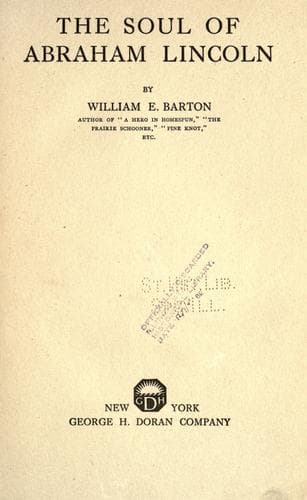
The Soul of Abraham LincolnBarton, William E. (William Eleazar)
Religion
The Soul of Abraham Lincoln
Barton, William E. (William Eleazar)
Lincoln, Abraham, 1809-1865 -- Religion; Presidents -- United States -- Biography
The solemn responsibilities of his office, the daily contemplation of
death as it menaced him and came into the homes of the people of his
country, the profound conviction that God was working His infinite
purpose through the war, and through the human agency of Lincoln
himself, took hold of the deepest impulses of his nature, and became
the controlling forces of his policy.
Lincoln was no theologian, but I do not find any authority for the
statement of Mr. Binns that Lincoln said, "the more a man knew of
theology, the farther he got away from the Spirit of Christ." It is
possible, of course, for a man to learn theology as an intellectual
system and to have little religion as a spiritual experience, and to
lose that little in the process of his logical subtleties: but Lincoln
was too just a man to make so sweeping and unjust an affirmation of
something of which he would certainly have admitted he knew very little.
The rock-bottom foundation of Abraham Lincoln's religious faith was
the ultra-Calvinism of his boyhood. He was reared a Predestinarian
Baptist; and while he never became a Baptist he never ceased to be
a Predestinarian. To this he added a strong rationalistic tendency,
inherent in his nature, and strengthened by his study of Paine and
Volney. This also he never wholly outgrew. As a lawyer who was not
well read, pleading before juries that cared little for the letter of
the law, he was accustomed to reduce his cases to simple principles of
elementary justice, and to rest all upon these principles. This habit
of thought and practice he applied also to his theology. His early
recollection of the epitaph of Johnny Kongapod was nothing less than
the application of the Golden Rule to theology--the assurance of an
eternal justice throned in heaven and intelligible on earth.
Thus, when he argued in favor of universal salvation he did it upon the
basis of the old Calvinistic theology with which he had been familiar
all his life. If God was, indeed, absolute sovereign, and as good as
He was great, and willed not that any should perish, then no one could
finally perish. Universal salvation became logically and ethically
compulsory. The Christ who tasted death for every man, did so as the
necessary means to the efficiency of a plan of salvation whereby the
curse of the fall was fully offset by the sacrifice of Christ, at the
instance of the sovereign will of God. As in Adam all died, even so in
Christ were all made alive. His theory of universal salvation was the
logical expression of his determinism, influenced by his rationalism
and confirmed by his appeal to a justice that would not accept a fall
more universal than the atonement of Christ. This was not because
Lincoln approached the theme from the direction of the grace of Christ,
but of the irresistibility of a divine decree. He profoundly believed
himself an instrument of the divine will, believing that will to be
right, and creation's final law.
Public-domain text, read in full here on John Shaqi.
Reviews
Reviews
No reviews yet
Be the first to share your thoughts on this work.
Elsewhere in the archive
Join the Discussion
Join the discussion
Sign in to leave a comment or review.
Sign InorCreate an account