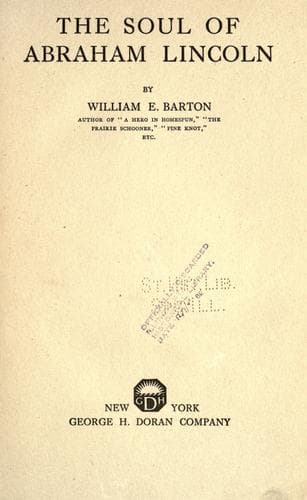
The Soul of Abraham LincolnBarton, William E. (William Eleazar)
Religion
The Soul of Abraham Lincoln
Barton, William E. (William Eleazar)
Lincoln, Abraham, 1809-1865 -- Religion; Presidents -- United States -- Biography
"In my intercourse with Mr. Lincoln, I learned that he believed in
a Creator of all things, who had neither beginning nor end, and,
possessing all power and wisdom, established a principle, in obedience
to which worlds move, and are upheld, and animal and vegetable life
come into existence. A reason he gave for his belief was that, in
view of the order and harmony of all nature which we behold, it would
have been created and arranged by some great thinking power. As to
the Christian theory, that Christ is God, or equal to the Creator,
he said that it had better be taken for granted; for, by the test of
reason, we might become infidels on that subject, for evidence of
Christ's divinity came to us in a somewhat doubtful shape; but that
the system of Christianity was an ingenious one at least, and perhaps
was calculated to do good."--LAMON: _Life of Lincoln_, p. 490.
Emphatic proof of Mr. Lincoln's faith is to be found in the positive
declaration of the two men who have done most to destroy the world's
confidence in it, Lamon and Herndon. In Lamon's later book of
_Reminiscences_, he did much to counteract the harsh and to my mind
incorrect impression given in his earlier book. But even in that book
he affirmed that while Lincoln rejected the New Testament as a book of
divine authority, he accepted its precepts as binding upon him and was
a believer in the supernatural even to credulity (p. 503, 504).
In that same work Herndon set forth that Lincoln was a firm believer in
God and attempted, as he said, "to put at rest forever the charge that
Mr. Lincoln was an atheist." He declared, however, that Lincoln did not
believe in a special creation, but in an "evolution under law"; not in
special revelation, "but in miracles under law"; and that "all things
both matter and mind were governed by laws universal, absolute, and
eternal" (p. 494).
To this Herndon gives even more emphatic testimony in his own book.
It must then be remembered that while in the loose nomenclature of
these authors Mr. Lincoln was an "infidel" it is these same authors
that assure us, as Lamon does, that "his theological opinions were
substantially those expounded by Theodore Parker."--LAMON: _Life of
Lincoln_, p. 486.
The question whether Lincoln's views underwent any substantial change
after leaving Springfield, has been answered in the negative by John G.
Nicolay, his private secretary at the White House; who affirmed that
"Mr. Lincoln did not, to my knowledge, in any way change his religious
views, opinions, or beliefs, from the time he left Springfield to the
day of his death."
This probably is correct. Mr. Lincoln was not conscious of any radical
change; but Mrs. Lincoln noticed a change in him after Willie's death,
which grew more pronounced after his visit to Gettysburg, and his own
faith, while undergoing no sudden and radical transformation, manifests
a consistent evolution.
Public-domain text, read in full here on John Shaqi.
Reviews
Reviews
No reviews yet
Be the first to share your thoughts on this work.
Elsewhere in the archive
Join the Discussion
Join the discussion
Sign in to leave a comment or review.
Sign InorCreate an account