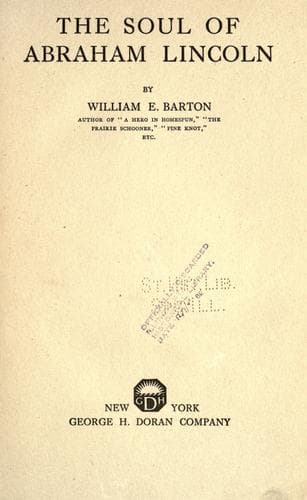
The Soul of Abraham LincolnBarton, William E. (William Eleazar)
Religion
The Soul of Abraham Lincoln
Barton, William E. (William Eleazar)
Lincoln, Abraham, 1809-1865 -- Religion; Presidents -- United States -- Biography
But we are not sure how much Mr. Nicolay believed Lincoln's views to
have been in need of change. He said in another place:
"Benevolence and forgiveness were the very basis of his character. His
nature was deeply religious, but he belonged to no denomination; he
had faith in the eternal justice and boundless mercy of Providence,
and made the Golden Rule of Christ his practical creed."--JOHN G.
NICOLAY, in article "Abraham Lincoln" in _Encyclopedia Britannica_,
ninth edition, XIV, 662.
Lincoln believed in divine destiny. He could hardly have believed
otherwise. The preaching to which he listened was such as to make it
all but impossible for him to hold any other views. He believed so
strongly that his own life was under divine guidance that Lamon and
Herndon speak of it in a thinly veiled scorn as though it were in
Lincoln's mind a mark of conscious superiority. Whether it was such
a mark or not does not now concern us. Lincoln believed in divine
guidance. He had faith in prayer and his practice of prayer is attested
by many and credible witnesses. A man of his temperament and training
and sense of responsibility could not well have been kept from praying.
Prayer was a necessary part of his life.
Lincoln not only had faith in prayer considered as a means of obtaining
results from God; he believed in it as establishing a relation with
God, a covenant relation, such as Abraham of old established. If such a
faith seems inconsistent with any other elements in the faith or doubt
of Abraham Lincoln, then the inconsistency must stand, for he did not
hold his views in entire consistency. In no respect does this faith in
the covenant relation emerge more strongly than in connection with the
issue of the Emancipation Proclamation. Fortunately, the evidence here
is incontestable. The Proclamation immediately became historic. Lincoln
had to autograph many copies to be sold at sanitary fairs--copies which
now sell at one thousand dollars each. Every incident relating to the
event became of immediate interest; and members of the Cabinet had to
group themselves for Carpenter's historic painting, of which he has
left so valuable a literary monument in his _Six Months in the White
House_. The members of the Cabinet had no time to invent or imagine
a set of incidents mythical in character, for each of them had to
describe many times, and immediately, the circumstances which attended
the reading of the Proclamation to the Cabinet on Monday, September 22,
1862.
This is the important and incontestable fact, that Lincoln did not
bring the Proclamation to the Cabinet for discussion, except as to
minor details. He had already determined to issue it. He had promised
God that he would do so.
This was the statement which profoundly impressed the members of the
Cabinet,--the President told them that he had already promised God that
he would free the slaves.
Public-domain text, read in full here on John Shaqi.
Reviews
Reviews
No reviews yet
Be the first to share your thoughts on this work.
Elsewhere in the archive
Join the Discussion
Join the discussion
Sign in to leave a comment or review.
Sign InorCreate an account