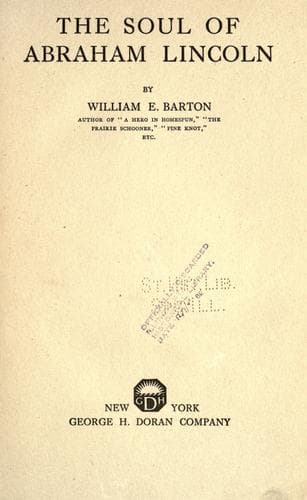
The Soul of Abraham LincolnBarton, William E. (William Eleazar)
Religion
The Soul of Abraham Lincoln
Barton, William E. (William Eleazar)
Lincoln, Abraham, 1809-1865 -- Religion; Presidents -- United States -- Biography
(1) He has made an effort to provide an adequate historical background
for the study of the religious life of Abraham Lincoln in the
successive periods of his life; and without immediately going too
deeply into the material of the main subject, to relate the man to his
environment. In this the author has been aided not only by books and
interviews with men who knew Lincoln, but by some years of personal
experience in communities where the social, educational, and religious
conditions were in all essential respects similar to those in which Mr.
Lincoln lived during two important epochs of his career. The author was
not born in this environment, but he spent seven years of his youth
and young manhood as a teacher and preacher in a region which give him
somewhat exceptional opportunities for a discriminating judgment.
(2) The author has assembled what is, so far as he knows, all the
essential evidence that has appeared in print concerning the religious
life and opinions of Mr. Lincoln, a larger body, as he believes, than
any previous writer has compiled. He has added to this all evidence
available to him from written and personal testimony.
He has subjected this evidence to a critical analysis, in an effort to
determine the degree of credibility with which its several portions may
reasonably be received. The author is not unaware that this is the most
disputable, as it is the most difficult part of his task, and, as he
believes, the most valuable part of it. Unless some such analysis is
made, the evidence resolves itself into chaos.
(3) Several entirely new avenues of investigation have been opened and
lines of evidence adduced which find no place in any previous book
on Mr. Lincoln's religious life, and very scant reference, and that
without investigation, in one or two of the biographies.
(4) The book also contains a constructive argument, setting forth the
conviction to which the author has come with regard to the faith of
Abraham Lincoln.
It is entirely possible that some readers will find themselves in
essential agreement with the author in the earlier parts of the book,
but will dissent in whole or in part from his own inferences. Whether
the reader agrees or disagrees with the author in his conclusions, he
will find in this book some material not elsewhere available for the
formation of an independent judgment. Nevertheless the author counts
himself justified not only in adducing the evidence but in stating
frankly the conclusion which to his mind this evidence supports.
Public-domain text, read in full here on John Shaqi.
Reviews
Reviews
No reviews yet
Be the first to share your thoughts on this work.
Join the Discussion
Join the discussion
Sign in to leave a comment or review.
Sign InorCreate an account