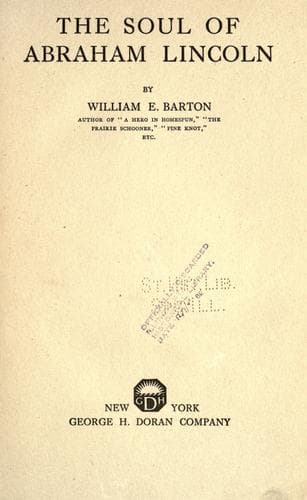
The Soul of Abraham LincolnBarton, William E. (William Eleazar)
Religion
The Soul of Abraham Lincoln
Barton, William E. (William Eleazar)
Lincoln, Abraham, 1809-1865 -- Religion; Presidents -- United States -- Biography
We must not pass lightly over the religious aspects of the Emancipation
Proclamation. Lincoln had submitted his first draft of the Proclamation
to the Cabinet on Tuesday, July 22, 1862, and it met with strong
opposition. Only two members of the Cabinet favored it; Seward and
Chase were strongly against it and the others thought it inopportune.
With the memory of this opposition, which in July had practically voted
the President down, Mr. Lincoln brought the matter again on September
22, not for discussion, for as he said he knew the view already of
every member of the Cabinet, but he had promised God that he would
do this thing. That very night Secretary Chase wrote in his diary an
account of the meeting, which is condensed as follows:
"_Monday, September 22, 1862._
"To Department about nine. State Department messenger came with
notice to heads of Departments to meet at twelve. Received sundry
callers. Went to White House. All the members of the Cabinet were in
attendance. There was some general talk, and the President mentioned
that Artemus Ward had sent him his book. Proposed to read a chapter
which he thought very funny. Read it, and seemed to enjoy it very much.
"The President then took a graver tone, and said, 'Gentlemen: I have,
as you are aware, thought a great deal about the relation of this
war to slavery; and you all remember that, several weeks ago, I read
to you an order I had prepared on this subject, which, on account of
objections made by some of you, was not issued. Ever since then my
mind has been much occupied with this subject, and I have thought, all
along, that the time for acting on it might probably come. I think the
time has come now. I wish it was a better time. I wish that we were in
a better condition. The action of the army against the Rebels has not
been quite what I should best like. But they have been driven out of
Maryland, and Pennsylvania is no longer in danger of invasion. When
the Rebel Army was at Frederick, I determined, as soon as it should be
driven out of Maryland, to issue a Proclamation of Emancipation, such
as I thought most likely to be useful. I said nothing to anyone, but I
made the promise to myself, and [hesitating a little] to my Maker. The
Rebel Army is now driven out, and I am going to fulfill that promise.
I have got you together to hear what I have written down. I do not
wish your advice about the main matter, for that I have determined for
myself. This, I say, without intending anything but respect for any
one of you. But I already know the views of each on this question.
They have been heretofore expressed, and I have considered them as
thoroughly and carefully as I can. What I have written is that which
my reflections have determined me to say. If there is anything in the
expressions I use, or in any minor matter, which any one of you thinks
had best be changed I shall be glad to receive the suggestions. One
other observation I will make.
Public-domain text, read in full here on John Shaqi.
Reviews
Reviews
No reviews yet
Be the first to share your thoughts on this work.
Elsewhere in the archive
Join the Discussion
Join the discussion
Sign in to leave a comment or review.
Sign InorCreate an account