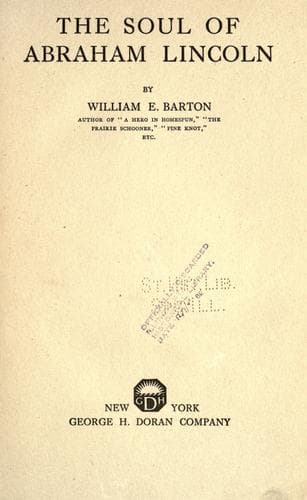
The Soul of Abraham LincolnBarton, William E. (William Eleazar)
Religion
The Soul of Abraham Lincoln
Barton, William E. (William Eleazar)
Lincoln, Abraham, 1809-1865 -- Religion; Presidents -- United States -- Biography
I know very well that many others
might, in this matter as in others, do better than I can; and if I was
satisfied that the public confidence was more fully possessed by any
one of them than by me, and knew of any constitutional way in which he
could be put in my place, he should have it. I would gladly yield it
to him. But though I believe that I have not so much of the confidence
of the people as I had some time since, I do not know that, all things
considered, any other person has more; and however this may be, there
is no way in which I can have any other man put where I am. I am here;
I must do the best I can, and bear the responsibility of taking the
course which I feel I ought to take.'"--WARDEN: _Life of S. P. Chase_,
pp. 481-82, quoted in Nicolay and Hay, VI, 159-60.
In the diaries of Secretaries Welles and Chase we have incontrovertible
testimony. The two records were made independently and on that
very night, and were not published for years afterward. There was
no possible collusion or reshaping of the testimony in the light
of subsequent events, no time for imagination to play any part in
enlarging upon the incident. The President recognized that the time was
not wholly propitious, that a majority of the Cabinet probably would
not be disposed to adopt his Proclamation if put to vote, that the
people's support of the administration was wavering and unpredicable
and none too certain to approve this measure. Under these conditions it
is impossible to consider the Emancipation Proclamation solely from the
standpoint either of political expediency or of military necessity. The
fact which silenced all opposition in the Cabinet was the President's
solemn statement that he had made a covenant with God, and that he must
keep it.
There is a sense in which the solemnity is heightened by the grotesque
incident of the chapter from Artemus Ward read at the beginning. There
is an aspect in which the sublimity of that Cabinet meeting's ending
is heightened by the ridiculousness of its beginning. In any event,
it shows that the mind of Abraham Lincoln that morning was in what
for him was a thoroughly healthy condition. However incongruous it
might have been for another man to begin so solemn a meeting with a
chapter from Artemus Ward, it was a mark of sanity, of thorough normal
psychology, when done by Abraham Lincoln. It showed that the moral
overstrain was finding its relief from excessive tension in what for
Lincoln was an entirely normal way.
Public-domain text, read in full here on John Shaqi.
Reviews
Reviews
No reviews yet
Be the first to share your thoughts on this work.
Elsewhere in the archive
Join the Discussion
Join the discussion
Sign in to leave a comment or review.
Sign InorCreate an account