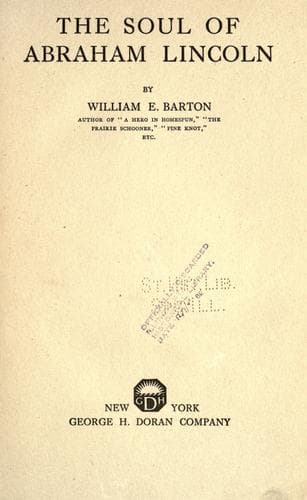
The Soul of Abraham LincolnBarton, William E. (William Eleazar)
Religion
The Soul of Abraham Lincoln
Barton, William E. (William Eleazar)
Lincoln, Abraham, 1809-1865 -- Religion; Presidents -- United States -- Biography
As before stated, these two contemporary accounts by Welles and Chase,
though made at the time, were not published until years afterward; but
there was another publication that was virtually contemporary. Frank
B. Carpenter, the artist, began almost immediately his noted painting
of the signing of the Emancipation Proclamation, and in the course of
his six months in the White House had long and repeated interviews with
all members of the Cabinet, and talked with them about every incident
connected with that event. He published his account in his book in
1866, while all the members of the Cabinet were living, and, so far as
known, was never objected to or proposed to be modified by any member
of the Cabinet. According to his statement, Lincoln told the Cabinet
that he had promised God that he would do this, uttering the last part
of this sentence in a low voice. Secretary Chase, who was sitting near
the President, asked Mr. Lincoln if he had correctly understood him,
and the President repeated what he had affirmed before, saying:
"I made a solemn vow before God, that if General Lee was driven back
from Pennsylvania, I would crown the result by the declaration of
freedom for the slaves."--_Six Months in the White House_, pp. 89, 90.
In this threefold attestation we have irrefutable testimony that
the determining motive of President Lincoln in his issue of the
Emancipation Proclamation was the keeping of his solemn covenant with
God.
It is all but impossible to exaggerate the significance of this
incident. The essential fact is as fully proved as human testimony
can possibly prove a fact. When we remember the extreme reticence of
Abraham Lincoln on all such matters, and the fact of which he must
have been painfully conscious that his Cabinet was not very favorably
disposed toward the thing that he proposed to do, his quiet, outspoken,
and repeated declaration that he had promised this thing to God is
sufficient in itself to settle forever the essentially religious
character of Abraham Lincoln. If we had no other word from his lips
touching on the subject of religion but this one, we should be assured
of his unfaltering belief in God, in a profound sense of his own
personal responsibility to God, in prayer, and a personal relation with
God.
This was no platitude uttered to meet the expectation of the religious
people of the United States; it was no evasive generality intended to
fit whatever religious desire might lie in the minds of those who heard
him. It was no play to the gallery; it was no masquerade; every motive
of pretense or hypocrisy or duplicity was absent. It was the sincere
expression of the abiding faith of Abraham Lincoln in God, and prayer,
and duty.
* * * * *
Public-domain text, read in full here on John Shaqi.
Reviews
Reviews
No reviews yet
Be the first to share your thoughts on this work.
Elsewhere in the archive
Join the Discussion
Join the discussion
Sign in to leave a comment or review.
Sign InorCreate an account