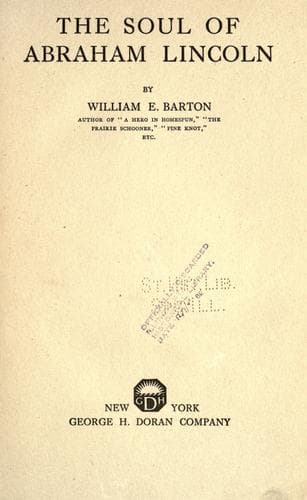
The Soul of Abraham LincolnBarton, William E. (William Eleazar)
Religion
The Soul of Abraham Lincoln
Barton, William E. (William Eleazar)
Lincoln, Abraham, 1809-1865 -- Religion; Presidents -- United States -- Biography
Some who have known of Lincoln's particular utterances on certain of
these points have been misled, as it appears to me, by the similarity
of some of these points to doctrines held by particular religious
sects and have sought to identify Lincoln more or less with those
denominations. The fact that he took portions of his positive thinking
from Theodore Parker and William Ellery Channing, does not necessitate
that he was a Unitarian; nor does the fact that he did not believe
in eternal punishment compel his classification with Universalists.
Theodore Parker and William E. Channing chanced to be the authors
whose writings came into his possession at a time when they served
to define particular aspects of his own faith. Horace Bushnell, or
Henry Ward Beecher might have served him quite as well and possibly in
some respects better. For Lincoln's Calvinism was too deep-rooted to
be eradicated; and a positive faith, both liberal and constructive,
that could have been grafted on to that root might very possibly have
served him better than anything so radical as in its nature to deny any
essential part of what he felt he must continue to believe. Parker and
Channing served him as James Smith's _Christian's Defence_ and Robert
Chambers' _Vestiges of Creation_ served him in assuring him that a man
could hold the views he held and know more about them than he knew and
still be a reverent Christian. Such a Christian Abraham Lincoln appears
to me to have been.
I do not think that any claim which I am here making for the faith of
Abraham Lincoln can be denied on the basis of any authentic utterance
of his. If at any point he is known to have said or written anything
which is apparently inconsistent with these affirmations, that
utterance I think will be found somewhere in this volume and the reader
will have no difficulty in finding it and in giving it its proper
weight. But I do not think the general position which this chapter sets
forth can be seriously shaken. In the sense which this chapter has
endeavored truthfully to set forth, Abraham Lincoln believed in God, in
Christ, in the Bible, in prayer, in duty, and in immortality.
Religion is one thing and theology is another. A love of flowers is one
thing and a knowledge of botany is another. A man may love a flower
and call it by the wrong name, or know no name for it. A man may have
the religion of Christ, and hold very wrong opinions or conjectures
concerning Christ. We are saved by faith, not by conjecture. No man
is saved or lost because of the correctness of his opinions. Correct
thinking is important; but it is not so important as a right attitude
toward spiritual realities and practical duties. Faith and opinion are
not unrelated, but neither are they identical.
Public-domain text, read in full here on John Shaqi.
Reviews
Reviews
No reviews yet
Be the first to share your thoughts on this work.
Elsewhere in the archive
Join the Discussion
Join the discussion
Sign in to leave a comment or review.
Sign InorCreate an account