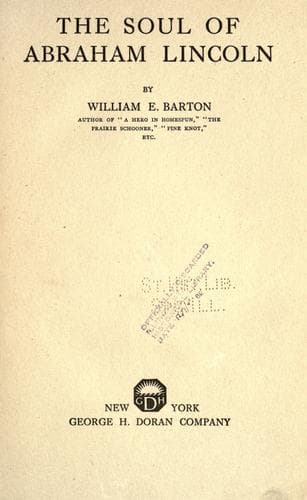
The Soul of Abraham LincolnBarton, William E. (William Eleazar)
Religion
The Soul of Abraham Lincoln
Barton, William E. (William Eleazar)
Lincoln, Abraham, 1809-1865 -- Religion; Presidents -- United States -- Biography
Too much of the effort to prove that Abraham Lincoln was a Christian
has begun and ended in the effort to show that on certain theological
topics he cherished correct opinions. That would not prove him to be
a Christian, nor would the lack of these certainly prove that he was
not a Christian. Religion is of the heart and life; theology is of the
brain and mind. Each is important, but theology is less important than
religion.
Abraham Lincoln was not a theologian, and several of his theological
opinions may have been incorrect; but there is good reason to believe
that he was a true Christian. The world has need of a few theologians,
and of a great many Christians.
It was Mr. Lincoln's custom when he read a paragraph which deeply
interested him, to draw a pencil line around it in the book; and if it
was something which he wished to commit to memory and meditate upon, he
often copied it upon a scrap of paper. I own a half page of notepaper
containing in Lincoln's handwriting and with his signature, a paragraph
from Baxter's "Saint's Rest." The manuscript was owned by Hon. Winfield
Smith, Lincoln's Attorney-General in 1864, and was among his private
papers when he died. The paragraph reads:
"It is more pleasing to God to see his people study Him and His will
directly, than to spend the first and chief of their effort about
attaining comfort for themselves. We have faith given us, principally
that we might believe and live by it in daily applications of Christ.
You may believe immediately (by God's help) but getting assurance of
it may be the work of a great part of your life."
It would be interesting to know just what was in Lincoln's mind when
he read this paragraph, and sat down with pen and ink to copy and
meditate upon it. The "comfort" which Baxter was referring to in
this passage was the comfort of assurance of salvation in Christ. It
was a theme on which Mr. Lincoln heard many sermons, first and last,
by Predestinarian preachers, both Baptist and Presbyterian. If a
man was among the elect, how could he be sure of it, and what means
could he take to make the assurance more certain? Baxter's answer was
that assurance in this matter is less important than to study and
obey God's will; and that faith is given us as something in whose
exercise we may live daily without greatly troubling ourselves about
fathomless mysteries. It was good doctrine for a man who had been
reared as Lincoln had been reared, and the remainder of the passage was
especially in line with his needs. He could believe immediately, even
though the assurance of faith was long delayed. That assurance might
be the work of a lifetime, but faith was something that might be lived
upon now. The thought is akin to that in the fine lines of Lizzie York
Case:
"_There is no unbelief:
For thus by day and night unconsciously
The heart lives by the faith the lips deny,--
God knoweth why._"
Public-domain text, read in full here on John Shaqi.
Reviews
Reviews
No reviews yet
Be the first to share your thoughts on this work.
Elsewhere in the archive
Join the Discussion
Join the discussion
Sign in to leave a comment or review.
Sign InorCreate an account