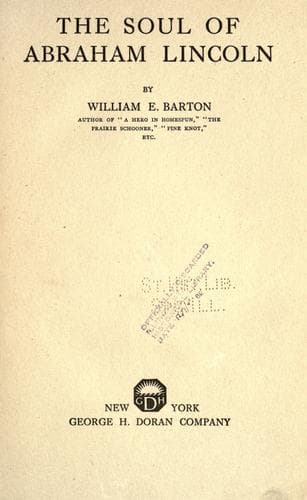
The Soul of Abraham LincolnBarton, William E. (William Eleazar)
Religion
The Soul of Abraham Lincoln
Barton, William E. (William Eleazar)
Lincoln, Abraham, 1809-1865 -- Religion; Presidents -- United States -- Biography
It may seem strange that any men should dare to ask a just God's
assistance in wringing their bread from the sweat of other men's
faces; but let us judge not, that we be not judged.... The Almighty
has His own purposes. "Woe unto the world because of offenses! For
it must needs be that offenses come; but woe to that man by whom the
offense cometh." If we shall suppose that American slavery is one of
those offenses which, in the Providence of God, must needs come, but
which having continued through His appointed time, He now will remove
and that He gives to both North and South this terrible war, as the
woe due to those by whom the offense came, shall we discern therein
any departure from those Divine attributes which the believers in a
living God always ascribe to Him. Fondly do we hope--perfectly do we
pray--that this mighty scourge of war may speedily pass away. Yet, if
God wills that it continue until all the wealth piled by the bondman's
two hundred and fifty years of unrequited toil shall be sunk, and
until every drop of blood drawn with the lash shall be paid by another
drawn with the sword, as was said three thousand years ago, so still
must it be said, "The judgments of the Lord are true and righteous
altogether."
With malice toward none; with charity for all; with firmness in the
right as God gives us to see the right, let us strive on to finish the
work we are in.--Second Inaugural, March 4, 1865. _Complete Works_,
II, 657.
No one of the foregoing quotations is taken from a private
conversation, nor copied from an unauthorized source. Some
very pleasing selections might have been made from reasonably
well-accredited sources, but all of the foregoing selections, without
any exception, are taken from the authentic writings and addresses
of Lincoln as compiled, edited, and authenticated by his private
secretaries, John G. Nicolay and John Hay.
We might go much farther and could find a considerable body of
additional material, but this is sufficient and more than sufficient
for our purpose. In these utterances may be found something of the
determinism that was hammered into Lincoln by the early Baptist
preachers and riveted by James Smith, along with some of the
humanitarianism of Parker and Channing, and much which lay unstratified
in Lincoln's own mind but flowed spontaneously from his pen or dropped
from his lips because it was native to his thinking and had come to be
a component part of his life. Anyone who cares to do so may piece these
utterances together and test his success in making a creed out of them.
They lend themselves somewhat readily to such an arrangement.
Public-domain text, read in full here on John Shaqi.
Reviews
Reviews
No reviews yet
Be the first to share your thoughts on this work.
Elsewhere in the archive
Join the Discussion
Join the discussion
Sign in to leave a comment or review.
Sign InorCreate an account