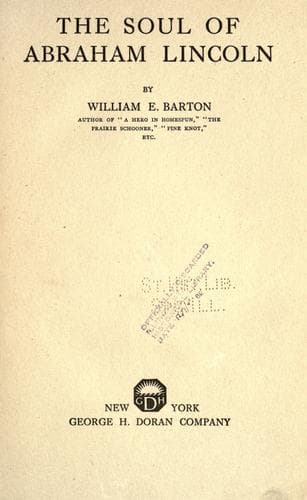
The Soul of Abraham LincolnBarton, William E. (William Eleazar)
Religion
The Soul of Abraham Lincoln
Barton, William E. (William Eleazar)
Lincoln, Abraham, 1809-1865 -- Religion; Presidents -- United States -- Biography
In the following arrangement no liberties have been taken except to
change the past tense to the present, or the plural to the singular,
and to add connectives, and preface the words "I believe." Except for
changes such as these, which in no way modify the sense or natural
force of the utterances, the creed which follows is wholly in the words
of Abraham Lincoln. A very little tampering with the text would have
made smoother reading, but this is not necessary. It has the simplicity
and the rugged honesty of the man who said these words.
THE CREED OF ABRAHAM LINCOLN IN HIS OWN WORDS
I believe in God, the Almighty Ruler of Nations, our great and good and
merciful Maker, our Father in Heaven, who notes the fall of a sparrow,
and numbers the hairs of our heads.
I believe in His eternal truth and justice.
I recognize the sublime truth announced in the Holy Scriptures and
proven by all history that those nations only are blest whose God is
the Lord.
I believe that it is the duty of nations as well as of men to own
their dependence upon the overruling power of God, and to invoke the
influence of His Holy Spirit; to confess their sins and transgressions
in humble sorrow, yet with assured hope that genuine repentance will
lead to mercy and pardon.
I believe that it is meet and right to recognize and confess the
presence of the Almighty Father equally in our triumphs and in those
sorrows which we may justly fear are a punishment inflicted upon us for
our presumptuous sins to the needful end of our reformation.
I believe that the Bible is the best gift which God has ever given to
men. All the good from the Saviour of the world is communicated to us
through this book.
I believe the will of God prevails. Without Him all human reliance is
vain. Without the assistance of that Divine Being, I cannot succeed.
With that assistance I cannot fail.
Being a humble instrument in the hands of our Heavenly Father, I desire
that all my works and acts may be according to His will; and that it
may be so, I give thanks to the Almighty, and seek His aid.
I have a solemn oath registered in heaven to finish the work I am in,
in full view of my responsibility to my God, with malice toward none;
with charity for all; with firmness in the right as God gives me to
see the right. Commending those who love me to His care, as I hope in
their prayers they will commend me, I look through the help of God to a
joyous meeting with many loved ones gone before.
APPENDICES AND BIBLIOGRAPHY
APPENDIX I
EXTRACT FROM NEWTON BATEMAN'S LECTURE ON LINCOLN WITH VARIANTS OF THE
FAREWELL ADDRESS, AT SPRINGFIELD, FEBRUARY 11, 1861.
BOTH for its own value as an incident in the life of Mr. Lincoln
and because it affords us opportunity of understanding the accuracy
of Newton Bateman's verbal memory, the following is quoted from his
lecture on Abraham Lincoln, a lecture delivered many times in the later
years of his life and printed by his family in 1899 after his death:
Public-domain text, read in full here on John Shaqi.
Reviews
Reviews
No reviews yet
Be the first to share your thoughts on this work.
Elsewhere in the archive
Join the Discussion
Join the discussion
Sign in to leave a comment or review.
Sign InorCreate an account