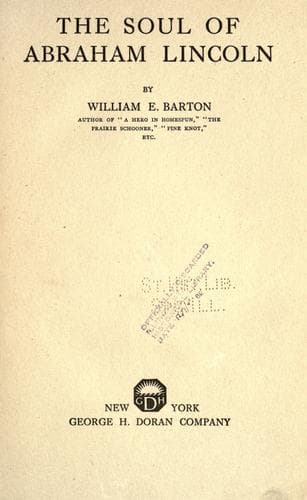
The Soul of Abraham LincolnBarton, William E. (William Eleazar)
Religion
The Soul of Abraham Lincoln
Barton, William E. (William Eleazar)
Lincoln, Abraham, 1809-1865 -- Religion; Presidents -- United States -- Biography
Presuming that the first of Colonel Lamon's libels upon Mr. Lincoln's
memory is thus sufficiently disposed of, I proceed to consider the
charges against his religious life and character. The best refutation
of these charges lies on the pages of the book in which they are
advanced. However skeptical Mr. Lincoln may have been in his earlier
life, Mr. Lamon persists in asserting and attempting to prove that he
continued a confirmed skeptic to the last: that he was an unbeliever in
the truth of the Christian religion, and died an infidel; that, while
"he was by no means free from a kind of belief in the supernatural,
he rejected the great facts of Christianity as wanting the support
of authentic evidence"; that, "during all the time of his residence
at Springfield and in Washington, he never let fall from his lips an
expression which remotely implied the slightest faith in Jesus Christ,
as the Son of God and the Saviour of men"; that "he was at all times an
infidel." From twenty-five to thirty pages of evidence is produced in
proof of this allegation.
But all this positive statement as to Mr. Lincoln's persistent and
final infidelity is contradicted by the admissions of the book itself.
It is admitted that there did come a time in Mr. Lincoln's life at
Springfield when he began to affiliate with Christian people, and to
give his personal presence and support to the Church. It is admitted
that he did so plausibly identify himself with the Christian community
that "his New Salem associates and the aggressive deists with whom he
originally united at Springfield gradually dispersed and fell away from
his side." Here is the fact, openly and squarely stated by Mr. Lamon,
that Mr. Lincoln, even while at Springfield, did make such a change in
his sentiments and bearing toward the Christian community, that "the
aggressive deists and infidels with whom he originally united gradually
dispersed and fell away from his side." He no sooner turned away from
them in sentiment than they turned away from him in fact.
Public-domain text, read in full here on John Shaqi.
Reviews
Reviews
No reviews yet
Be the first to share your thoughts on this work.
Elsewhere in the archive
Join the Discussion
Join the discussion
Sign in to leave a comment or review.
Sign InorCreate an account