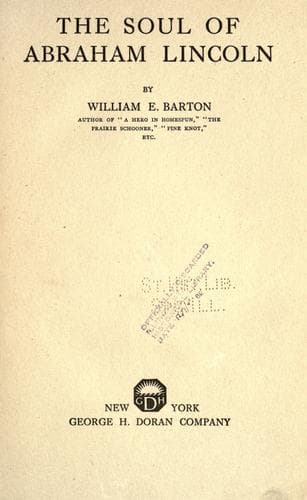
The Soul of Abraham LincolnBarton, William E. (William Eleazar)
Religion
The Soul of Abraham Lincoln
Barton, William E. (William Eleazar)
Lincoln, Abraham, 1809-1865 -- Religion; Presidents -- United States -- Biography
But how does the biographer attempt to explain this? How does he
account for this admitted and observable change in Mr. Lincoln's life,
that relieved him of the presence of so much aggressive deistical
company? Why, by means of an explanation that kills the accusation
itself--an explanation that fastens upon Mr. Lincoln the very charge
of hypocrisy against which he professes to defend him. He accounts for
this admitted and observable change in the attitude of Mr. Lincoln
towards the Christian community, not by supposing that there was any
sincerity about it, but by affirming that he was trying "to play a
sharp game on the Christians of Springfield!" It was because "he was
a wily politician, and did not disdain to regulate his religious
manifestations with reference to his political interests"; and because,
"seeing the immense and augmenting power of the churches, he aspired
to lead the religious community, foreseeing that in order to his
political success he must not appear an enemy within their gates." And
yet, if we are to believe Colonel Lamon, he was an enemy all the while
at heart; and while attending church, and supporting the Gospel, and
making Sabbath school speeches, and speeches before the Bible Society,
he was at heart a disbeliever of the truth and an antagonist of the
cause which he professed to be supporting. In other words, he was all
these years playing the arrant hypocrite; deceiving the Christian
community and wheedling it for political purposes; playing the role
of a gospel hearer in the sanctuary, and a hail fellow well met with
profane fellows of the baser sort in the private sanctum of infidelity
or "aggressive deism."
Strangely enough, however, Colonel Lamon and his companion in
authorship not only praise Mr. Lincoln's greatness, but laud
his singular conscientiousness and integrity of motive almost
to perfection. Says Mr. Herndon, "He was justly entitled to the
appellation, Honest Abe"; "honesty was his pole star; conscience, the
faculty that loves the just and the right, was the second great quality
and _forte_ of Mr. Lincoln's character." "He had a deep, broad, living
conscience. His great reason told him what was true and good, right and
wrong, just or unjust, and his conscience echoed back the decision,
and it was from this point he spoke and wove his character and fame
among us. His conscience ruled his heart." [See Herndon's letter in
Carpenter's _Life of Lincoln_.]
Public-domain text, read in full here on John Shaqi.
Reviews
Reviews
No reviews yet
Be the first to share your thoughts on this work.
Elsewhere in the archive
Join the Discussion
Join the discussion
Sign in to leave a comment or review.
Sign InorCreate an account