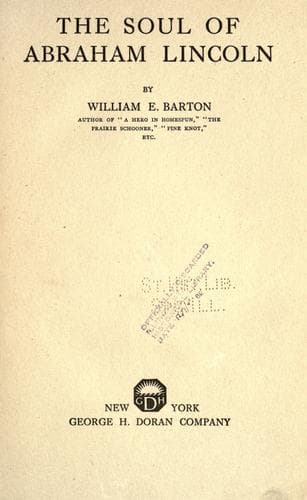
The Soul of Abraham LincolnBarton, William E. (William Eleazar)
Religion
The Soul of Abraham Lincoln
Barton, William E. (William Eleazar)
Lincoln, Abraham, 1809-1865 -- Religion; Presidents -- United States -- Biography
In confirmation of this, Mr. Lamon goes on to show that Mr. Lincoln
scorned everything like hypocrisy or deceit. In fact he makes his hero
to be such a paragon of honesty and conscious integrity of motive
that he would not undertake to plead a bad cause before a jury if he
could possibly shift the responsibility over on to some other lawyer,
whose conscience was not quite so tender. He brings in the testimony
of a most reputable lawyer of another place in confirmation of this,
who states: "That for a man who was for a quarter of a century both a
lawyer and a politician, Mr. Lincoln was the most honest man I ever
knew. He was not only morally honest but intellectually so. He could
not reason falsely; if he attempted it he failed. In politics he never
would try to mislead. At the bar, when he thought he was wrong, he was
the weakest lawyer I ever saw." "In a closely contested case where Mr.
Lincoln had proved an account for a client, who was, though he knew it
not, a very slippery fellow, the opposing attorney afterward proved a
receipt clearly covering the entire case. By the time he was through
Mr. Lincoln was missing. The court sent for him to the hotel. 'Tell the
judge,' said Mr. Lincoln, 'that I can't come; my hands are dirty and I
came over to clean them.'"
Page after page is thus taken to show Mr. Lincoln's singular
conscientiousness and honesty, his incapability of hypocrisy or deceit,
as a lawyer, a politician and a gentleman. And yet these consistent
biographers go back on all this testimony of their own mouths when they
come to explain the admitted change in his life when he began to lean
toward the church, and the "aggressive deists" parted company with him.
Then they find it convenient to call him a "wily politician," who is
"playing a sharp game with the Christians"; "the cautious pretender
who does not disdain to regulate his religious manifestations with
reference to his political interests." They saddle upon him the vilest
hypocrisy and deceit, and make him "act the liar's part," in order to
send him down to posterity an infidel. On one page they reason that Mr.
Lincoln could not have made any such admissions of his belief in the
Christian religion as have been maintained, as such admissions would be
contrary to his well-known character; on the next page they affirm that
Mr. Lincoln could not act the hypocrite; and on a third they do not
hesitate to attribute to him the very grossest duplicity, in their zeal
to fasten on him the charge of permanent skepticism. They go back on
their own logic, eat their own argument, and give the lie to the very
charge they are laboring with such considerable pains to establish.
Public-domain text, read in full here on John Shaqi.
Reviews
Reviews
No reviews yet
Be the first to share your thoughts on this work.
Elsewhere in the archive
Join the Discussion
Join the discussion
Sign in to leave a comment or review.
Sign InorCreate an account