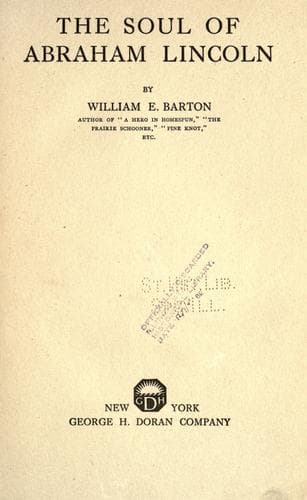
The Soul of Abraham LincolnBarton, William E. (William Eleazar)
Religion
The Soul of Abraham Lincoln
Barton, William E. (William Eleazar)
Lincoln, Abraham, 1809-1865 -- Religion; Presidents -- United States -- Biography
"Nevertheless, I am no fatalist. I believe in the supremacy of the
human conscience, and that men are responsible beings; that God has a
right to hold them, and will hold them, to a strict personal account
for the deeds done in the body. But, sirs, I do not mean to give you a
lecture upon the doctrines of the Christian religion. These are simply
with me the convictions and realities of great and vital truths,
the power and demonstration of which I see now in the light of this
our national struggle as I have never seen before. God only knows
the issue of this business. He has destroyed nations from the map of
history for their sins. Nevertheless my hopes prevail generally above
my fears for our own Republic. The times are dark, the spirits of ruin
are abroad in all their power, and the mercy of God alone can save us."
So did the President discourse until we felt we were imposing on his
time, and rising we took our leave of him, confident that he would be
true to those convictions of right and duty which were derived from so
deep a Christian philosophy.
Yours truly,
BYRON SUNDERLAND.
The Rev. Dr. Miner, Pastor of the First Baptist Church of Springfield,
who was intimately acquainted with Mr. Lincoln, and visited him
and his family in Washington previous to his death, has left most
interesting testimony in reference to Mr. Lincoln's religious
sentiments, confirmatory of what has been given, and which is preserved
in the archives of the University of Chicago. Dr. Miner sums up his
impressions of Mr. Lincoln as follows: "All that was said during that
memorable afternoon I spent alone with that great and good man is
engraven too deeply on my memory ever to be effaced. I felt certain
of this fact, that if Mr. Lincoln was not really an experimental
Christian, he was acting like one. He was doing his duty manfully,
and looking to God for help in time of need; and, like the immortal
Washington, he believed in the efficacy of prayer, and it was his
custom to read the Scriptures and pray himself." And here I would
relate an incident which occurred on the 4th of March, 1861, as told
me by Mrs. Lincoln. Said she: "Mr. Lincoln wrote the conclusion of
his inaugural address the morning it was delivered. The family being
present, he read it to them. He then said he wished to be left alone
for a short time. The family retired to an adjoining room, but not so
far distant but that the voice of prayer could be distinctly heard.
There, closeted with God alone, surrounded by the enemies who were
ready to take his life, he commended his country's cause and all
dear to him to God's providential care, and with a mind calmed with
communion with his Father in heaven, and courage equal to the danger,
he came forth from that retirement ready for duty."
Public-domain text, read in full here on John Shaqi.
Reviews
Reviews
No reviews yet
Be the first to share your thoughts on this work.
Elsewhere in the archive
Join the Discussion
Join the discussion
Sign in to leave a comment or review.
Sign InorCreate an account