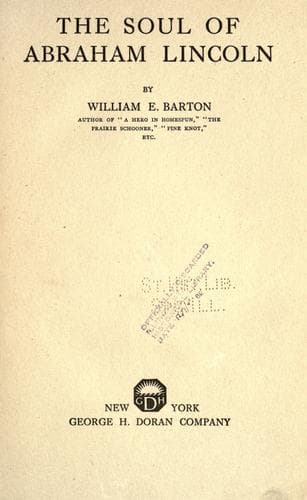
The Soul of Abraham LincolnBarton, William E. (William Eleazar)
Religion
The Soul of Abraham Lincoln
Barton, William E. (William Eleazar)
Lincoln, Abraham, 1809-1865 -- Religion; Presidents -- United States -- Biography
With such testimony, gathered from gentlemen of the highest standing,
and much more that I could add to confirm it, I leave the later life
and religious sentiments of Abraham Lincoln to the dispassionate and
charitable judgment of a grateful people. While it is to be regretted
that Mr. Lincoln was not spared to indicate his religious sentiments by
a profession of his faith in accordance with the institutions of the
Christian religion, yet it is very clear that he had this step in view,
and was seriously contemplating it, as a sense of its fitness and an
apprehension of his duty grew upon him. He did not ignore a relation
to the Christian church as an obsolete duty and an unimportant matter.
How often do we hear him thanking God for the churches! And he was fast
bringing his life into conformity to the Christian standard. The coarse
story-telling of his early days was less indulged in in his later life.
Hon. Isaac N. Arnold, and Mr. Carpenter, as well as Mr. Lincoln's
physician at Washington, Dr. Stone, all testify that "while his stories
and anecdotes were racy, witty, and pointed beyond all comparison,"
yet they "never heard one of a character needing palliation or
excuse." His physician, Dr. Stone, testifies that "Mr. Lincoln was the
purest-hearted man he ever came in contact with."
His disposition to attend the theater in later life (if to anyone it
seems to need apology) was not so much a fondness for the playhouse
as a relief from his mental anxiety, and an escape from the incessant
pressure of visitors at the White House. "It is a well-known fact,"
says Dr. Miner, "that he would not have been at the theater on that
fatal night, but to escape the multitude who were that evening pressing
into the White House to shake hands with him. It has been said that
Mrs. Lincoln urged her husband to go to the theater against his will.
This is not true. On the contrary, she tried to persuade him not to
go, but he insisted. He said, 'I must have a little rest. A large and
overjoyed, excited people will visit me tonight. My arms are lame
by shaking hands with the multitude, and the people will pull me to
pieces.' He went to the theater, not because he was interested in the
play, but because he was care-worn and needed quiet and repose. Mrs.
Lincoln informed me that he seemed to take no notice of what was going
on in the theater from the time he entered it till the discharge of
the fatal pistol. She said that the last day he lived was the happiest
of his life. The very last moments of his conscious life were spent
in conversation with her about his future plans, and what he wanted
to do when his term of office expired. He said he wanted to visit
the Holy Land and see the places hallowed by the footprints of the
Saviour. He was saying there was no city he so much desired to see as
_Jerusalem_; and with that word half spoken on his tongue, the bullet
of the assassin entered his brain, and the soul of the great and good
Public-domain text, read in full here on John Shaqi.
Reviews
Reviews
No reviews yet
Be the first to share your thoughts on this work.
Elsewhere in the archive
Join the Discussion
Join the discussion
Sign in to leave a comment or review.
Sign InorCreate an account