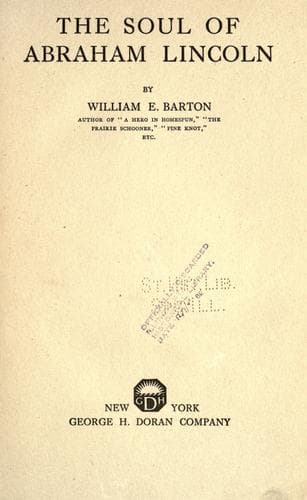
The Soul of Abraham LincolnBarton, William E. (William Eleazar)
Religion
The Soul of Abraham Lincoln
Barton, William E. (William Eleazar)
Lincoln, Abraham, 1809-1865 -- Religion; Presidents -- United States -- Biography
was no hardship in compelling the members of such assemblages to
establish their loyalty by oath and certificate, and insisted that his
order, while providing against public danger, really protected the
purity and the freedom of religion.
In the course of these controversies between secessionist ministers
and commanding generals an incident occurred which deserves a moment's
notice, as it led to a clear and vigorous statement from Mr. Lincoln
of his attitude in regard to these matters. During the year 1862 a
somewhat bitter discussion arose between the Rev. Dr. McPheeters of
the Vine Street Church in St. Louis and some of his congregation in
regard to his supposed sympathies with the rebellion. Looking back
upon the controversy from this distance of time it seems that rather
hard measure was dealt to the parson; for although, from all the
circumstances of the case, there appears little doubt that his feelings
were strongly enlisted in the cause of the rebellion, he behaved with
so much discretion that the principal offenses charged against him by
his zealous parishioners were that he once baptized a small rebel by
the name of Sterling Price, and that he would not declare himself in
favor of the Union. The difference in his church grew continually more
flagrant and was entertained by interminable letters and statements on
both sides, until at last the provost-marshal intervened, ordering the
arrest of Dr. McPheeters, excluding him from his pulpit, and taking the
control of his church out of the hands of its trustees. This action
gave rise to extended comment, not only in Missouri, but throughout
the Union. The President, being informed of it, wrote[78] to General
Curtis disapproving the act of the provost-marshal, saying, in a terse
and vigorous phrase, which immediately obtained wide currency, "The
United States Government must not, as by this order, undertake to run
the churches. When an individual in a church, or out of it, becomes
dangerous to the public interest he must be checked; but let the
churches, as such, take care of themselves." But even this peremptory
and unmistakable command did not put an end to the discussion. Taking
the hands of the Government away from the preacher did not quench the
dissensions in the church, nor restore the pastor to the position
which he occupied before the war; and almost a year later some of the
friends of Dr. McPheeters considered it necessary and proper to ask the
intervention of the President to restore to him all his ecclesiastical
privileges in addition to the civil rights which they admitted he
already enjoyed. This the President, in a letter[79] of equal clearness
and vigor, refused to do. "I have never interfered," he said, "nor
thought of interfering, as to who shall, or shall not, preach in any
church; nor have I knowingly or believingly tolerated anyone else to
so interfere by my authority"; but he continues, "If, after all, what
is now sought is to have me put Dr.
Public-domain text, read in full here on John Shaqi.
Reviews
Reviews
No reviews yet
Be the first to share your thoughts on this work.
Elsewhere in the archive
Join the Discussion
Join the discussion
Sign in to leave a comment or review.
Sign InorCreate an account