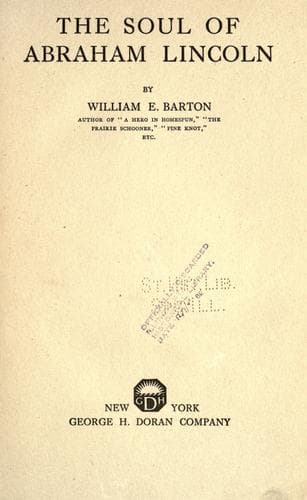
The Soul of Abraham LincolnBarton, William E. (William Eleazar)
Religion
The Soul of Abraham Lincoln
Barton, William E. (William Eleazar)
Lincoln, Abraham, 1809-1865 -- Religion; Presidents -- United States -- Biography
"I am now told that the military were not in possession of the
building; and yet that in pretended execution of the above they,
the military, put one set of men out of and another set into the
building. This, if true, is most extraordinary. I say again, if
there be no military need for the building, leave it alone, neither
putting anyone in or out of it, except on finding someone preaching or
practicing treason, in which case lay hands upon him, just as if he
were doing the same thing in any other building, or in the streets or
highways."[83]
He at last made himself understood and his orders respected; yet
so widespread was the tendency of generals to meddle with matters
beyond their jurisdiction, that it took three years of such vehement
injunctions as these to teach them to keep their hands away from the
clergy and the churches.
Lincoln had a profound respect for every form of sincere religious
belief. He steadily refused to show favor to any particular
denomination of Christians; and when General Grant issued an unjust and
injurious order against the Jews, expelling them from his department,
the President ordered it to be revoked the moment it was brought to his
notice.[84]
He was a man of profound and intense religious feeling. We have no
purpose of attempting to formulate his creed; we question if he
himself ever did so. There have been swift witnesses who, judging from
expressions uttered in his callow youth, have called him an atheist,
and others who, with the most laudable intentions, have remembered
improbable conversations which they bring forward to prove at once his
orthodoxy and their own intimacy with him. But leaving aside these
apocryphal evidences, we have only to look at his authentic public
and private utterances to see how deep and strong in all the latter
part of his life was the current of his religious thought and emotion.
He continually invited and appreciated, at their highest value, the
prayers of good people. The pressure of the tremendous problems by
which he was surrounded; the awful moral significance of the conflict
in which he was the chief combatant; the overwhelming sense of personal
responsibility, which never left him for an hour--all contributed
to produce, in a temperament naturally serious and predisposed to a
spiritual view of life and conduct, a sense of reverent acceptance of
the guidance of a Superior Power. From that morning when, standing
amid the falling snowflakes on the railway car at Springfield, he asked
the prayers of his neighbors in those touching phrases whose echo rose
that night in invocations from thousands of family altars, to that
memorable hour when on the steps of the Capitol he humbled himself
before his Creator in the sublime words of the second inaugural, there
is not an expression known to have come from his lips or his pen but
proves that he held himself answerable in every act of his career to
a more august tribunal than any on earth. The fact that he was not
Public-domain text, read in full here on John Shaqi.
Reviews
Reviews
No reviews yet
Be the first to share your thoughts on this work.
Elsewhere in the archive
Join the Discussion
Join the discussion
Sign in to leave a comment or review.
Sign InorCreate an account