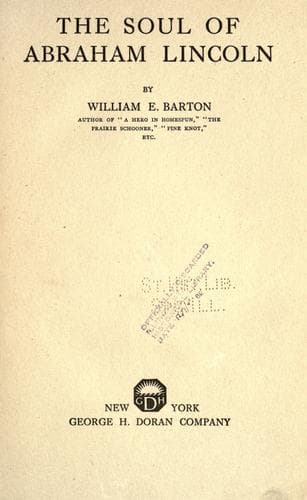
The Soul of Abraham LincolnBarton, William E. (William Eleazar)
Religion
The Soul of Abraham Lincoln
Barton, William E. (William Eleazar)
Lincoln, Abraham, 1809-1865 -- Religion; Presidents -- United States -- Biography
Thomas Lincoln was a thriftless farmer who blamed external conditions
for his misfortunes. Following a second appearance of the "milk sick,"
which came to southern Indiana in the winter of 1829, he and his family
removed in March of 1830 to Illinois. Abraham was twenty-one years of
age. He assisted his father to get established in the new home, to
which a wearying journey of fourteen days had brought the household,
and then set out in life for himself. For several months he worked
near home, but in the spring of 1831 he made his second flatboat trip
to New Orleans. The boat stuck on a dam at Rutledge's mill at New
Salem, and his ingenuity in getting it over the dam won him local fame
and had something to do with his subsequent establishment of a home
there. The flatboat stuck on April 19, 1831. In June he returned to
New Salem and entered into business with Denton Offutt in a small and
non-remunerative general store. While waiting for the opening of this
store he became acquainted with Mentor Graham, a school teacher of
local celebrity, whom Lincoln assisted as clerk of a local election,
and through him learned the contents of Kirkham's Grammar, and also
acquired the essential elements of surveying. New Salem was a sporadic
town which had no good reason to exist. It was established in 1829 and
lasted barely seven years. It was located on the Sangamon River, some
fifteen miles from Springfield.
In February, 1832, this flatboat hand, then working as clerk, began
his canvass for the Legislature, his formal announcement of candidacy
appearing March 9. He was defeated, but received an encouraging local
vote. In 1832 he had a brief experience as a soldier, serving in the
Black Hawk War, starting in pursuit of the Indians on April 27 and
returning in July. Excepting for his absences at the Black Hawk War
and in attendance upon the meetings of the Legislature in Vandalia,
he was in New Salem practically during the whole of the history of
that little town. He established a partnership in the firm of Lincoln
& Berry, keepers of a general store, a business for which he had no
qualification, and he accumulated debts, which he was unable to pay in
full until after his first term in Congress seventeen years later. On
May 7, 1833, he became postmaster of the microscopic village of New
Salem, and held that position until May 30, 1836, about which date the
town disappeared. In August, 1834, he was elected to the Legislature,
then sitting at Vandalia, and had an important share in the removal of
the state capital from there to Springfield.
Public-domain text, read in full here on John Shaqi.
Reviews
Reviews
No reviews yet
Be the first to share your thoughts on this work.
Join the Discussion
Join the discussion
Sign in to leave a comment or review.
Sign InorCreate an account