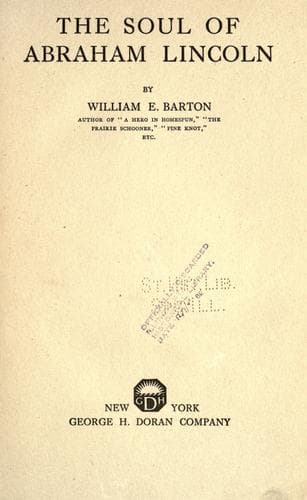
The Soul of Abraham LincolnBarton, William E. (William Eleazar)
Religion
The Soul of Abraham Lincoln
Barton, William E. (William Eleazar)
Lincoln, Abraham, 1809-1865 -- Religion; Presidents -- United States -- Biography
"There was sound preaching in those days. The preachers preached hell
and damnation more than they do now. They could hold a sinner over
the pit of fire and brimstone till he could see himself hanging by a
slender thread, and he would surrender and accept the gospel that was
offered to him."--ONSTOTT: _Lincoln and Salem_, pp. 120, 127.
Of one of these preachers, Abraham Bale, Onstott says:
"He had a habit when preaching of grasping his left ear with his hand,
then leaning over as far as he could and lowering his voice. He would
commence to straighten up and his voice would rise to a high key. He
would pound the Bible with his fist and stamp the floor, and carry
everything before him. He created excitement in the first years of
his ministry in Salem. He was a Baptist, though not of the hardshell
persuasion."--ONSTOTT: _Lincoln and Salem_, p. 149.
This was the general and accepted habit of Baptist preachers in that
movement, and the author has heard scores of sermons delivered in this
fashion.
Of the religious life of early Illinois and of frontier communities in
general, Professor Pease says:
"Religion came to be the most universally persuasive intellectual
force of the frontier. As might be expected, on the frontier the first
tendency was toward a disregard of religious observances. The emigrant
from the older settled regions left behind him the machinery and the
establishment of sectarian religion. Until that machinery could be set
up again on the frontier he lived without formal worship and often for
the time at least the sense of the need of it passed out of his life.
In cases where observance had been due to social convention, there was
no doubt a welcome feeling of freedom and unrestraint.
"Normally the frontiersman was unreligious. Birkbeck noted with relish
the absence of ceremony at baptism or funeral and the tolerance
of all backwoods preachers alike, whether they raved or reasoned.
Sunday was a day for riot and disorder. Other observers looked with
horror on such a state of things, did their best to set up at least
stated regular worship, and noted an improvement in morals as a
result."--PEASE: _Centennial History of Illinois_, II, 23.
There were, however, some compensations. Fordham wrote:
"This is not the land of hypocrisy. It would not here have its reward.
Religion is not the road to wordly respectability, nor a possession of
it the cloak of immorality."--_Personal Narrative_, p. 128.
Of the sporadic nature of much of the religious effort on the frontier,
Professor Buck says:
"In spite of the tremendous exertions of the pioneer preachers,
many of the remote settlements must have been practically devoid of
religious observances, and even in the older settlements the influence
of occasional visitations, however inspiring they might be, was often
lacking in permanence."--_Illinois in 1818_, p. 179.
Public-domain text, read in full here on John Shaqi.
Reviews
Reviews
No reviews yet
Be the first to share your thoughts on this work.
Join the Discussion
Join the discussion
Sign in to leave a comment or review.
Sign InorCreate an account