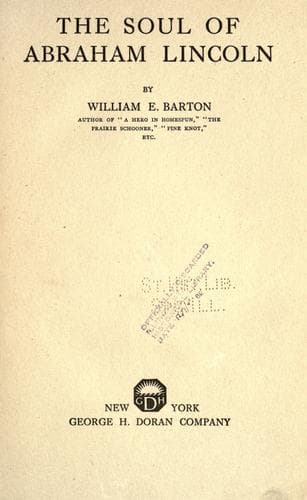
The Soul of Abraham LincolnBarton, William E. (William Eleazar)
Religion
The Soul of Abraham Lincoln
Barton, William E. (William Eleazar)
Lincoln, Abraham, 1809-1865 -- Religion; Presidents -- United States -- Biography
"As many of these preachers were nearly destitute of learning and
knowledge, they made up in loud hallooing and violent action what they
lacked in information. And it was a matter of astonishment to what
length they could spin out a sermon embracing only a few ideas. The
merit of a sermon was measured somewhat by the length of it, by the
flowery language of the speaker, and by his vociferation and violent
gestures. Nevertheless, these first preachers were of incalculable
benefit to the country. They inculcated justice and morality, and
to the sanction of the highest human motives to regard them, added
those which arise from a belief of the greatest conceivable amount of
future rewards and punishments. They were truly patriotic also; for
at a time when the country was so poor that no other kind of ministry
could have been maintained in it, they preached without charge to
the people, working week days to aid the scanty charities of their
flocks, in furnishing themselves with a scantier living. They believed
with a positive certainty that they saw the souls of men rushing to
perdition; and they stepped forward to warn and to save, with all
the enthusiasm and self-devotion of a generous man who risks his own
life to save his neighbor from drowning. And to them are we indebted
for the first Christian character of the Protestant portion of this
people."--THOMAS FORD: _History of Illinois_, pp. 38-40.
"Of the hostility of certain of the early Baptists to enlightenment,
there is abundant evidence in their own fierce opposition to their
ablest minister, John Mason Peck. He was born in 1789 in the
Congregational atmosphere of Connecticut, but, becoming a Baptist
by conviction, became a missionary to the West in 1817. His foes
were they of his own household. They fiercely fought against Bible
societies, Sunday schools, and missionary societies. In 1828, when
Peter Cartwright and James Lemen endeavored to secure the passage of a
bill for the prevention of vice and immorality, there was an attempt
to amend it in the interests of certain of the Hardshell Baptists
by adding to the section against the disturbance of public worship
a clause to fine in any sum not less than five dollars or more than
fifteen any person who on Sunday would sell any pamphlet or book or
take up an offering 'for the support of missionary societies, Bible
societies, or Sunday school.' There were not less than twelve members
of the House of Representatives who voted for this bill."--PEASE:
_Centennial History of Illinois_, II, 28, 29.
Public-domain text, read in full here on John Shaqi.
Reviews
Reviews
No reviews yet
Be the first to share your thoughts on this work.
Join the Discussion
Join the discussion
Sign in to leave a comment or review.
Sign InorCreate an account