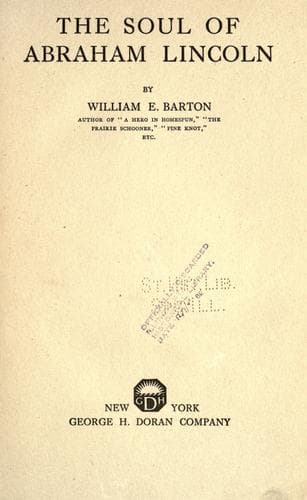
The Soul of Abraham LincolnBarton, William E. (William Eleazar)
Religion
The Soul of Abraham Lincoln
Barton, William E. (William Eleazar)
Lincoln, Abraham, 1809-1865 -- Religion; Presidents -- United States -- Biography
He was unsettled in love and unsettled in religion, though he had been
on speaking terms with both. He had loved and lost Ann Rutledge, and
he did not love Mary Owens and could not lose her. He was about to
begin one of the loneliest periods of his very lonely life. For a year
only one woman in Springfield spoke to him, and she would rather not
have done so. He did not go to church nor mingle in society, but faced
the hard and bitter problems that confronted him in earning a living,
making some small payments on his debt, settling his relations with
Mary Owens, and possibly giving some thought to his soul. But this was
not a time of one of his spiritual high water-marks.
If we had seen Abraham Lincoln as he entered New Salem and again
six years later as he left it, we should have found small reason to
anticipate very much of what afterward occurred. But looking back upon
him in the light of what occurred afterward, we discern the "promise
and potency" of the great man he afterward became in the sad young man
who already had become a leader of men, and had earned the right to be
called "Honest Abe."
CHAPTER V
THE ENVIRONMENT OF LINCOLN'S LIFE IN SPRINGFIELD
ABRAHAM LINCOLN became a resident of Springfield on Wednesday, March
15, 1837, and continued to live there until his removal, Saturday,
February 11, 1860, to assume his duties as President of the United
States. He was accepted as partner by his friend and former commander,
Major John T. Stuart, and shared an office in which politics was the
major interest and law was incidentally practiced. His partnership
with Stuart continued for four years, from April 27, 1837, until April
14, 1841. His next partnership was with Judge Stephen T. Logan, and
extended from April 14, 1841, to September 20, 1843.
He then formed a partnership with William H. Herndon which began on
the day of the dissolution of the partnership with Judge Logan and was
never formally dissolved. Lincoln had a working alliance with some
lawyer in almost every county seat which he habitually visited, whereby
the local lawyer secured the cases and worked them up, and Lincoln took
them in charge as senior counsel when they came to trial.[18] These
were not formal partnerships, though they were often so spoken of. This
method gave him a large practice, and brought him into contact and
collision with the ablest lawyers in central and southern Illinois.
In 1838 and again in 1840 he was re-elected to the Legislature, and
showed little of the ability which he later manifested, but was a
faithful member, and he flung himself with ardor into the noisy
campaign of 1840.
In 1842 he had his "duel" with James T. Shields, and later had the good
sense to be ashamed of it.
In 1846 he ran for Congress, and at this third attempt was elected,
taking his seat December 6, 1847, and continuing for two years.
Public-domain text, read in full here on John Shaqi.
Reviews
Reviews
No reviews yet
Be the first to share your thoughts on this work.
Elsewhere in the archive
Join the Discussion
Join the discussion
Sign in to leave a comment or review.
Sign InorCreate an account